Manual Pole Saws: Choose Reach You Can Control
A pole saw puts a blade at the end of a long handle, and longer is not always better. Choose reach you can control, check the locks and know which branches belong to a tree professional.
By GardenHelmPublished 4-minute readMore in Pruning & Cutting
In this guide
Try a pole saw at full extension before buying; its balance tells you more than the spec sheet. A manual pole saw is a pruning blade on a long handle, with no motor, battery or chain, and it is a good tool for the occasional small, high branch on a fruit tree or ornamental. The pole you want is the one you can steer accurately at the length you need, with locks you trust and a blade that fits into the branch crotch. Extra reach you cannot control makes for ragged cuts and risky work.
Is this a pole-saw job at all?
Look at the whole tree and the ground under it first. A branch you can reach may still be too heavy, too awkwardly placed or too damaged for homeowner work. Work out where the cut piece will fall or swing, and clear people, pets and cars from that zone.
University of Minnesota Extension’s pruning guidance notes that pole saws extend reach but make clean cuts harder, advises against pruning near utility wires and recommends professional help for large trees. Call the utility about anything near its lines; no pole length or material makes that a DIY job.
Hire a qualified arborist when the job would mean climbing, using a ladder with a long tool, cutting over a roof or dealing with a large hanging or broken limb. For jobs that stay on your list, you need firm footing, a clear view of the cut and a spot to one side of the branch, never directly beneath it.
Pole length and “reach”
Listings mix up three numbers:
| Measurement | Tells you |
|---|---|
| Collapsed or broken-down length | Whether it fits your shed or car |
| Extended tool length | How much pole you are actually holding up |
| Working reach | An estimate that often adds an assumed user height and arm position |
Check which one the maker quotes and whether it includes the blade. Weight on a long pole feels much heavier than the number on the box suggests, so try it at the extension you expect to use if a store allows. You also need room to angle the blade and move through a full stroke; a branch at the very end of your reach rarely gets a clean cut.
Telescoping or sectional
Telescoping poles slide out from inside each other. Check where the locks are, how easy they are to tighten and confirm, and whether the instructions require a minimum overlap between sections. Silky’s Hayauchi product information describes a spring-loaded button and friction clamps that work together on its telescoping pole, a reminder that every part of the lock matters.
Sectional poles join separate pieces. Check the approved order and number of sections, how the joints engage and where you will keep the spares. Never mix sections from different systems because the diameters look alike.
Before buying, find out whether replacement locks, connectors and blades are sold. A damaged section should be replaced, not taped.
The cutting head
Look at the blade shape, the teeth and the mounting. Curved blades and hooks change how much space the head needs, so picture the whole head entering a crowded branch junction. Most Japanese-style pruning saws cut on the pull stroke; follow the direction the maker gives rather than sawing hard both ways.
An adjustable head angle helps with awkward branches, as long as it locks firmly and you can still see the cut. Treat any maximum branch diameter as a ceiling for ideal conditions. Wood condition, access and your control matter more than the figure.
Saw only, or with a pruner?
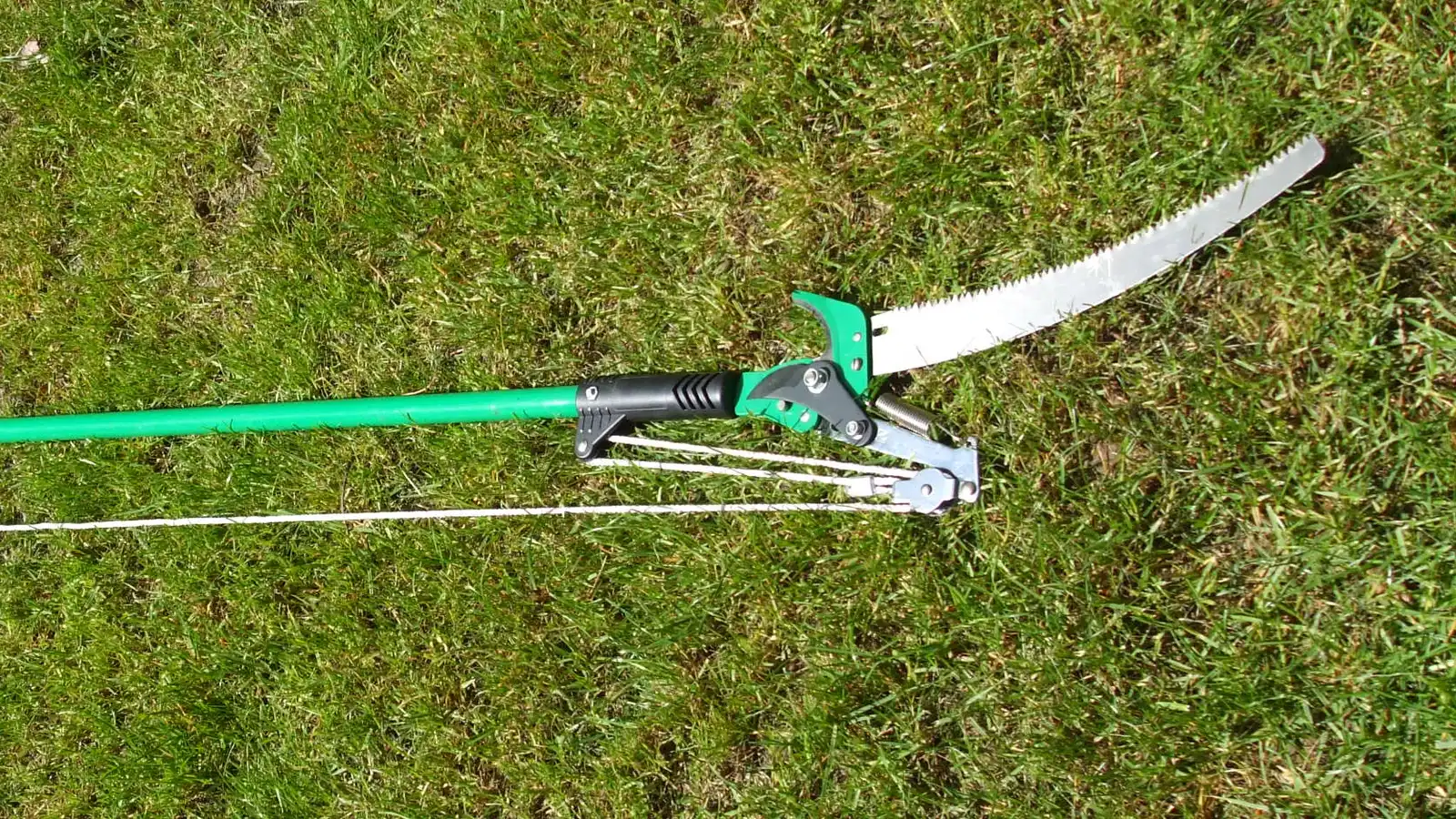
Combination tools add a rope-operated lopper jaw for thin shoots. That is handy for light pruning, but the jaw and rope add bulk around the head and can tangle while you saw. The jaw has its own capacity limits, separate from the saw’s. Check whether the rope, pulley and blades can be replaced. If you will not use the lopper, a saw-only head is simpler and lighter.
Make the right cut
Decide why the branch is coming off and where the cut belongs. Extension pruning guidance stresses cutting just outside the branch collar, the slightly swollen ring where branch meets trunk, without leaving a stub or cutting into the trunk. If you cannot see the collar clearly from the ground, get help.
Do not use a pole saw to shorten the top of a tree. Minnesota Extension warns against topping, which leaves stubs and weak regrowth (pruning guidance).
Read the tool’s instructions, including the protective equipment it calls for; eye protection and a hard hat are sensible whenever material is falling from overhead. Keep others out of the work area and stop if your footing, view or control changes.
Care and storage
Before each use, check the blade mounting, pole sections, locks and any rope. A slipping lock means the saw is out of service until fixed. Find out whether the blade is meant to be sharpened or replaced; many saws with impulse-hardened teeth have replace-only blades. Store the saw clean and dry with its blade guard on, secured so it cannot fall on someone reaching past it.
If you only prune once or twice a year, compare the cost and storage of a tool with simply having an arborist do the job, particularly for larger trees. Branches you can reach from the ground need only hand pruners or loppers, covered in the garden tools hub.
Written from manufacturer and retailer information and general garden practice. GardenHelm has not physically tested the products discussed here. How we choose products