Electric Chainsaw Guide: Corded Supply, Battery Kits and Chain Care
Electric does not mean no chain oil. Compare corded and battery saws as complete working packages, with a real cable plan for corded and a real kit for battery.
By GardenHelmPublished 4-minute readMore in Pruning & Cutting
In this guide
An electric chainsaw still needs bar-and-chain oil, and the tank may be empty out of the box. EGO’s CS1610 manual, for example, says the saw does not ship filled with oil and tells you to remove the battery before filling it. Once that is settled, the real choice is simple: a corded saw suits work within reach of an outdoor outlet and a correctly sized cord, while a battery saw suits jobs scattered around the property, as long as you price the complete kit. See our pruning and cutting category for the wider tool range. This is a buying guide, not a felling lesson.
Corded: plan the cable first
Cord size is set by the saw’s manual, not by whatever is in the garage. Oregon’s North American CS1500-091 manual requires an outdoor-rated extension cord, at least 14 AWG for runs up to 50 feet and 12 AWG for 51 to 100 feet. Its diagram shows the cord looped through a strain relief at the rear handle, and it tells you to inspect insulation and plugs for damage. Oregon CS1500-091 manual, page 18 Those figures apply to that saw. OSHA’s chainsaw fact sheet makes the same general point: size extension cords according to the saw maker’s instructions.
Walk the route with a tape. Measure from the outlet to the farthest cut, around beds and fences, and add slack so you are never pulling the saw against a taut cord. If the answer is more than 100 feet, or the cord would cross the area where branches fall, a battery saw is the cleaner solution. A cord also needs constant attention while you cut, because it is easy to drag it into the chain’s path.
Battery: compare what is in the box
Battery saws are sold as bare tools and as kits, often under nearly identical names. EGO lists the CS1610 as the bare saw, the CS1611 as a kit with a 2.5Ah battery and standard charger, and the CS1613 as a kit with a 4.0Ah battery and standard charger. EGO CS1610 family
That suffix is what you are really choosing. A bare tool is a bargain only if you already own a battery and charger confirmed to fit that saw. A matching brand name and a similar battery shape do not prove compatibility, so get the maker’s list. Without existing packs, compare kit against kit and write down the battery and charger model numbers in each listing.
A bigger pack buys more cutting between charges, but nobody can tell you how many cuts you will get without knowing the wood. For a weekend of storm cleanup, a second pack charging while you work may matter more than the largest single battery.
The oil and chain routine
The EGO CS1610 manual’s parts diagram separates the chain-tension knob from the side-cover knob and identifies the lock-off button, trigger and front hand guard/chain brake. EGO CS1610 manual, pages 21 and 25 Learn those controls from your saw’s own manual: tool-free tensioners differ from brand to brand, and a loose chain or loose cover is a hazard.
Before each session, OSHA’s fact sheet says to check the controls, chain tension, bolts and handles and to confirm every safety device works. Keep the reservoir topped up with bar-and-chain oil, and stop to refill when the level runs low.
When you order a replacement chain, use the full part identification the maker gives, not just the bar length. Pitch, gauge and drive-link count all have to match. For a used saw, establish the exact model and its approved bar and chain before you run it.
Safety gear and limits
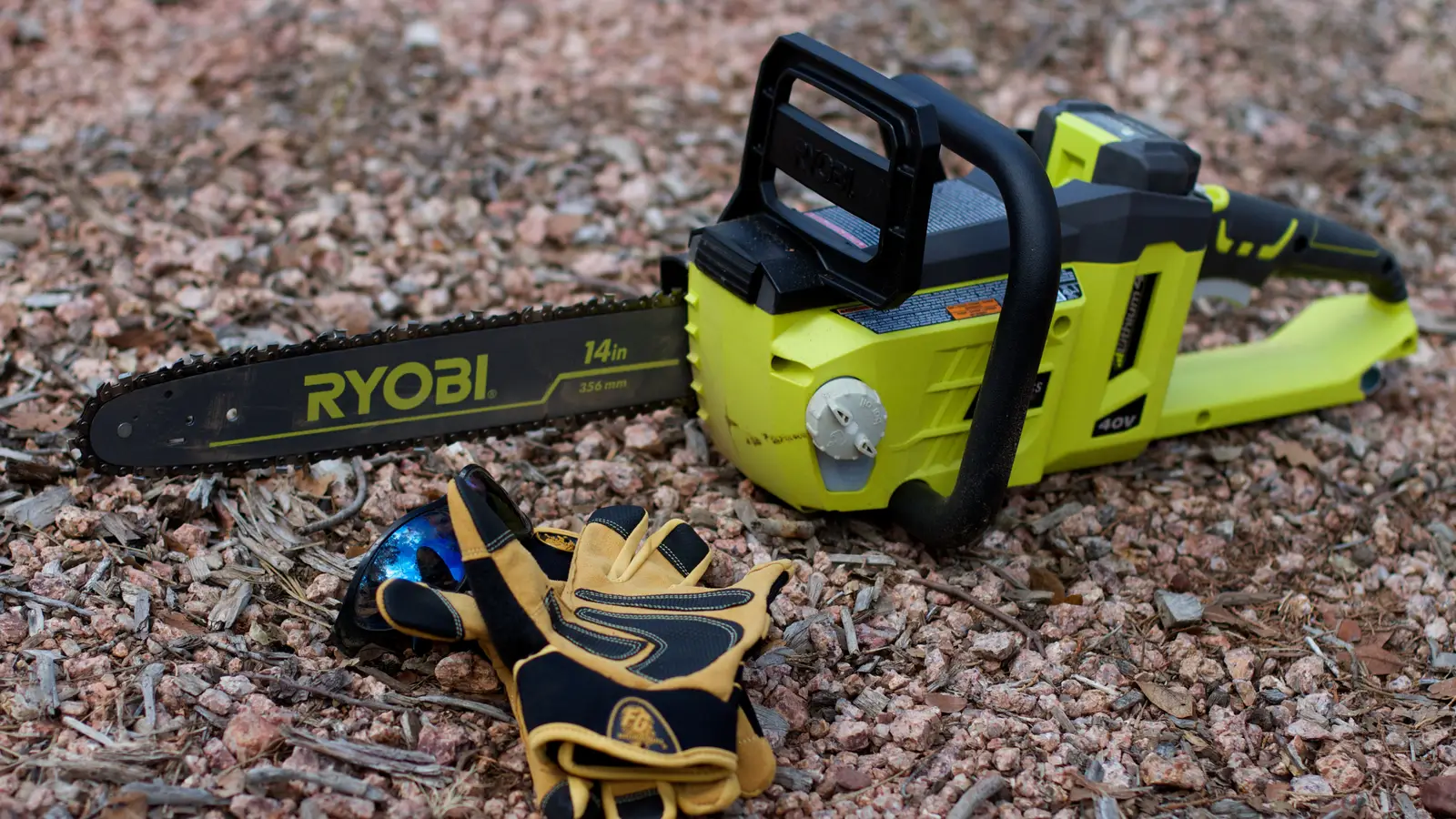
A quiet electric motor makes a chainsaw feel tamer than it is. The chain cuts just as readily, and kickback happens just as fast. OSHA’s chainsaw fact sheet lists the protective equipment employers must supply for chainsaw work, and it is a sensible baseline at home: head protection, hearing protection, eye and face protection, protective footwear, leg protection such as work pants or chaps, and work gloves. It also says to start the saw on the ground or another firm support with the brake engaged, keep both hands on the handles, never cut directly overhead and avoid cutting with the kickback zone, the upper part of the bar tip. OSHA chainsaw fact sheet
The same sheet flags higher-risk work: trees on unstable ground or slopes, heavy lean, rot or a tendency to split, and any cutting above shoulder height or from a ladder. A longer bar or bigger battery does not make those jobs safer. Hand them to a qualified arborist.
Which should a first-time buyer pick?
If nearly all your cutting happens within about 50 feet of an outdoor outlet, a corded saw with the specified cord keeps the purchase simple. If the work is spread across a large yard, or you already own a battery platform, a battery kit avoids the cord entirely. Either way, ask the seller to show you the matching manual. If the listing lacks a full model number, or the manual cannot be matched to the saw, take it off your list.
Written from manufacturer and retailer information and general garden practice. GardenHelm has not physically tested the products discussed here. How we choose products