Lawn Mower for Small Yards: Choose by Grass, Layout and Storage
In a small yard the best mower is easy to steer, cuts at the right height and stores without a fight. Measure the grass you mow and the gate before comparing power types.
By GardenHelmPublished 5-minute readMore in Lawn Mowers
In this guide
How tall is your grass on the day you actually get around to mowing? Answer that truthfully and most of the small-yard decision is made. A reel mower is a pleasure on a lawn you cut every week and a struggle on one you cut when you remember. For a small lawn with trees, sharp turns or small beds, University of Maine Extension favors a walk-behind mower, and calls manual single-reel mowers “an excellent choice for small lawns.”
That gives a three-way shortlist: reel, cordless battery push, or corded electric. Gas is still a fair choice for a small lawn if you already maintain engines, but it asks the most of your garage.
Reel: the quiet option with a height ceiling
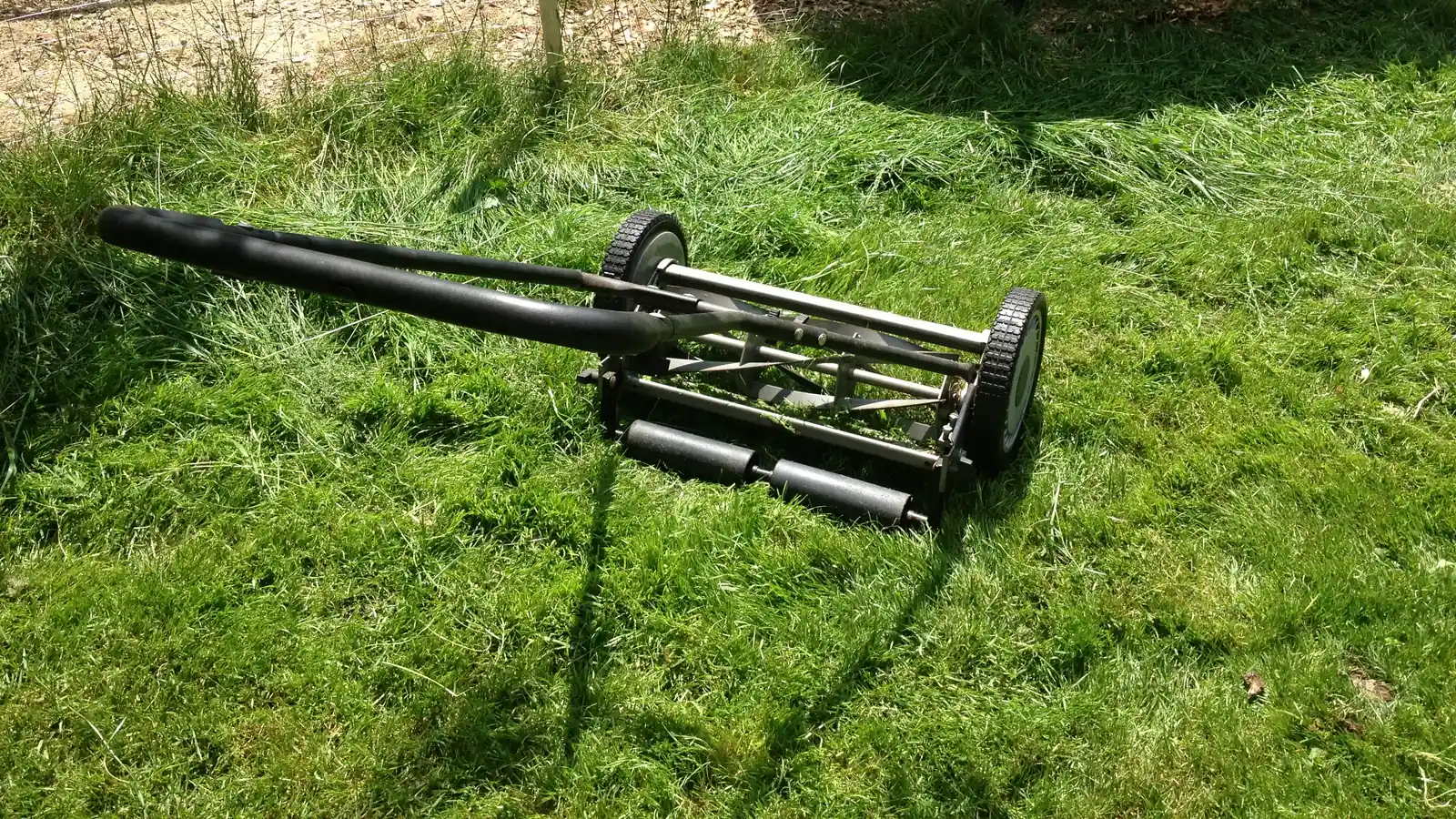
A reel mower scissors the grass between a spinning cylinder and a fixed bed knife, with no engine. Clemson’s mowing factsheet puts reels at cuts of 2 inches or less, says lower cuts need more blades on the reel, and says they do best on bermudagrass and zoysiagrass in maintained turf, on a fairly smooth surface, since uneven ground gets scalped. University of Minnesota Extension draws the same contrast between the mechanisms, saying rotary machines handle taller grass more readily and reels suit small, easily managed lawns.
So a reel suits a short, fine lawn that is cut often. If yours is a tall fescue or a lawn kept at 3 inches or more, check the maximum height setting before you look at anything else. Clemson’s mowing guide is a good place to check your grass against a recommended mowing height. And a reel does not rescue a lawn that got away from you: Clemson’s advice for overgrown grass is to raise the cutting height first and bring it down gradually, and a reel may have no setting high enough to start.
Battery push: for lawns with no cord route
A cordless mower solves the problem of pools, paths and trees in the way of a cord. What you are buying is a mower plus a pack plus a charger, so compare the kit and not the bare price. Runtime comes from the pack and the load: EGO’s manual for its LM2110 and LM2120 family lists approximate times of 25 to 60 minutes depending on model and load, and says grass condition changes them. Its tip for stretching a charge is to cut no more than 1 1/2 inches of grass in a pass.
If the lawn needs more than one charge, a second pack is the fix, but only if the charger is approved for it. Our lawn-mowers category has related buying guides, and the model’s manual settles which packs fit.
Self-propel is optional. On EGO’s LM2120SP, per the manual, the self-propel control works separately from the blade switch and has a speed knob, so you can walk the mower back to the shed with the blade stopped. That is one maker’s design. If your yard has long runs, ask whether powered travel is worth the added weight. If it is all short runs between beds, it may not be.
Corded: cheapest to run, if the cord route works
A corded mower has no pack to buy or replace, but you are dragging a cable through the yard. Greenworks’ manual for its 25022 corded mower gives a sense of the requirements: an outdoor-rated extension cord, a minimum of 14 AWG for 50 feet or less (use the next heavier gauge if in doubt), GFCI protection on the circuit or outlet, and a cord retainer on the mower to keep the plug from pulling out. It also tells you to inspect the cord before each use, replace it if damaged, and keep it clear of the working area. Greenworks 25022 manual. Another maker’s figures will differ.
Sketch the cord’s path for each lawn section. A clear rectangle beside the outlet is easy. A lawn behind a pool or wrapped around three trees can mean snagging the cable every few feet.
Spec sheets can disagree with themselves. The LawnMaster MEB1114K page gives a 14-inch cutting width in a feature bullet and 15 inches in its specification table, with height settings from 1.4 to 3 inches. Look for the width in the operator’s manual.
Gas
UF/IFAS Extension suggests a manual reel or electric walk-behind for a moderately sized yard, and recommends a tune-up for gas mowers every three months or about every 25 hours of use, covering the oil, spark plug and air filter. UF/IFAS lawn mower care. If a gas mower you already own cuts well, there is little reason to replace it for the sake of a small lot.
Measure the grass, the gate and the shed
Measure each patch of lawn as a rough rectangle and add them up: a 20-by-30-foot patch is 600 square feet. Then walk the route between patches and note the narrowest gate, any steps and the soft ground.
Storage often decides between close finalists. EGO’s manual shows its handle folding to a locked storage position, and says to store the mower upright or flat, lay it flat if possible, and keep an upright mower stable and out of children’s reach because a tip-over can damage the mower or hurt someone. A mower that folds flat slides under a shelf, and a rigid one claims a corner. Measure the folded size against the space, and check the weight with the battery or bag fitted, since you will be lifting it.
Cut width is how wide a pass is. The mower’s overall width is what has to fit the gate, so compare that separately.
Match the mower to the yard
For a small, fine-textured lawn mowed weekly, with a plan to enjoy the quiet, a reel is a good candidate. For several small patches with obstacles and no outlet nearby, a battery push mower. For one compact lawn right beside an outdoor outlet, a corded model costs the least to run. A rider seldom belongs on a small lot, because turning and storage work against it.
Before the first cut, clear toys, branches and loose objects, and keep children, bystanders and pets away. Disconnect the spark plug wire, remove the battery or unplug the cord before you clear a jam or touch the blade, and never bypass the bail switch or safety button. Self-propel is no approval for a slope: follow the model’s terrain limits and judge the footing yourself, because a small lawn can still hold unsafe ground.
Written from manufacturer and retailer information and general garden practice. GardenHelm has not physically tested the products discussed here. How we choose products