Polycarbonate Greenhouses: Panel Types, Thickness and What to Check in a Kit
How polycarbonate compares with glass and film, what twin-wall and multiwall panels change, how thickness affects light and insulation, and what to ask before buying a kit.
By GardenHelmPublished 10-minute readMore in Greenhouses
What this guide compares
- Panel type (single-wall, twin-wall or multiwall)
- Panel thickness and insulation value
- Clear or diffused light
- UV-protected outer face and warranty against yellowing
- Stated snow and wind ratings
- Frame material, base and ventilation
In this guide
We may earn a commission from links on this page, at no extra cost to you. How this works
Stand inside a glass greenhouse at noon and the shadows of the glazing bars fall crisp on the bench. Under twin-wall polycarbonate the light goes soft and even, almost like an overcast day, and the walls feel warmer to the hand on a cold morning. That is the bargain in one picture: polycarbonate trades clarity for diffusion, insulation and panels that are very hard to break. For most home growers, the useful questions are which wall type, how thick, whether the UV-protected face is genuine and correctly fitted, and whether the frame and base suit the weather.
If you have not settled on a site, size and placement yet, start with how to choose a greenhouse. This guide is about the glazing and what it changes in the rest of the kit.
Glass, polycarbonate or film
| Strengths | Trade-offs | |
|---|---|---|
| Glass | Clearest light, does not scratch or yellow | Heavy, breaks, single pane insulates poorly |
| Polycarbonate | Light, impact resistant, multiwall insulates | Less clear, scratches, ages over years |
| Poly film | Cheapest cover for large areas | Replaced every few years, punctures |
Glass suits a permanent, heavy-framed greenhouse where clear views and looks matter most. Film suits big, low-cost tunnels. Polycarbonate sits between them and works well in owner-assembled kits because the panels are light to handle, though cut edges and installation tools still call for the protective measures in the manual. Prospiant, a greenhouse manufacturer, says polycarbonate has about 200 times the impact resistance of glass (Prospiant).
Weighing a polycarbonate tunnel against an aluminum and glass house? High tunnel or glass greenhouse compares the two in practice.
Wall types: single, twin and multiwall
The wall construction does more to define the greenhouse than the word polycarbonate does.
- Single-wall (solid or corrugated). One layer. The clearest polycarbonate and closest to glass in light, but with little insulation.
- Twin-wall. Two skins joined by ribs, leaving air channels (flutes) along the length of the panel. The trapped air insulates. This is the panel most hobby kits use.
- Triple-wall and multiwall. Three or more skins. Better insulation and more diffusion, at the cost of less light, thicker panels and a higher price.
Those internal ribs are also what scatters the light. Diffused light reaches lower leaves and plants deeper in the canopy, casts softer shadows and is less likely to scorch foliage in strong sun. It does nothing for air temperature, though, and you lose any clear view out through a multiwall panel.
The sheet profile matters as much as the material. “Polycarbonate sheet” can mean a corrugated single layer or a flat multiwall panel with channels, and they use different fixings and closures. Gothic Arch Greenhouses lists both kinds in its rigid-coverings catalog.
Thickness: what 4, 6, 8 and 10 mm change
Thicker twin-wall panels insulate a little better and are stiffer, which helps on a roof carrying snow. Light transmission barely moves between twin-wall thicknesses; the real drop comes with triple-wall and beyond. Gothic Arch Greenhouses, a US manufacturer, lists these figures for its clear panels (rigid greenhouse coverings):
| Clear panel | R-value | Light |
|---|---|---|
| 4 mm twin-wall | 1.47 | 85% |
| 6 mm twin-wall | 1.639 | 80% |
| 8 mm twin-wall | 1.724 | 80% |
| 10 mm twin-wall | 1.923 | 80% |
| 10 mm triple-wall | 2.128 | 74% |
| 16 mm triple-wall | 2.50 | 74% |
A higher R-value means less heat loss. The same page lists its corrugated single-layer sheet at R-0.83 with up to 92% light, and says its twin-wall offers 50% more insulation than single-pane glass. Prospiant gives a similar spread, from R-1.54 for 6 mm twin-wall to R-3.2 for 16 mm five-wall, with 76 to 80% light through multiwall panels.
These are two makers’ figures for their own panels. A kit’s panels may differ, and doors, vents and frame joints leak heat too, so use the numbers to compare panel types, not to forecast a heating bill.
For unheated season extension, light matters more than insulation, and in Gothic Arch’s figures every clear twin-wall thickness passes 80 to 85% of light, so a thinner, cheaper twin-wall panel gives up little. Of the kits GardenHelm lists, only Bloomcabin’s two tunnels state a panel thickness; the High Tunnel Greenhouse page gives 6 mm polycarbonate with UV protection. If those panels are twin-wall, Gothic Arch’s table puts that thickness at about 80% light and R-1.639, which is the unheated profile; the page does not say whether they are twin-wall, so ask before you rely on the comparison. If you plan to heat through winter, thicker or triple-wall panels cut conductive loss, but compare the whole structure’s heat loss, including ventilation and air leaks, before paying for the upgrade, and remember that a thicker panel does not by itself make a kit suitable for snow.
Tinted panels block far more light. Gothic Arch lists its bronze twin-wall at 42% and opal at 30%, which can suit a sunroom or a very hot site but is too dark for most vegetables.
The UV-protected face
Unprotected polycarbonate breaks down and yellows in sunlight. Greenhouse-grade panels carry a UV-protected outer layer, usually co-extruded into the surface, and that side must face out. A panel fitted backward degrades early, so if a kit’s instructions do not show which side is which, get an answer before the first panel goes up.
Palram’s SUNLITE documentation is a good example of how makers handle this: it identifies the UV-protected face with its masking film and offers separate technical and installation documents. Follow the documents for the sheet you actually have; another product may mark its face differently.
Prospiant says most polycarbonate warranties cover about 10 to 15 years, with 10 years for yellowing, and that twin-wall panels can last more than 20 years with care. Read what a kit’s warranty says about the panels specifically, since the frame warranty is often separate. Clean with mild soap, water and a soft cloth; abrasive pads and harsh solvents damage the coating.
Glazing details that keep panels working
Flutes and end closures. Condensation can form inside twin-wall flutes. Panel ends are normally sealed with tape or end caps, with the bottom end allowing water to drain, and the flutes should run vertically so moisture can escape. Check that the kit includes the closures.
Condensation on the inside face. Warm, damp air meets a cold panel and condenses. Twin-wall stays warmer on the inside than a single sheet, so it drips less, and some panels have an anti-drip coating that makes water run off as a film. Ventilation remains the main control: open the vents on mild days, even in winter.
Expansion. Polycarbonate moves with temperature more than glass does. Kits allow for it with clips, gaskets and slightly oversized channels, so do not overtighten screws through panels and keep the gaps the instructions specify.
Hail, snow and wind. Impact resistance is why many people choose polycarbonate in hail country, but hail can still damage panels, so compare each product’s hail information and impact warranty. Snow is a slower test: it loads the roof for days, and the limit is usually the frame and how the panels are held, not the sheet itself. Compare a kit’s stated snow and wind ratings with what your area gets. The Limited Edition and Pyramid pages below both state 67 mph for wind and 43 lb/ft² for snow, conditional on correct anchoring and base. The High Tunnel page repeats those figures in one section but gives 160 kg/m² (about 33 lb/ft²) in its specifications, so ask Bloomcabin which figure applies before you compare it with your local snow load. Clear snow only from a safe position as the manual directs; never climb on the roof or push on loaded panels.
Replacing a panel
Start with the greenhouse model, size and panel position, then find the original part number or installation drawing. Send the supplier a photo of the panel edge and its fittings. Record:
- wall construction (solid, twin-wall or other multiwall) and profile;
- thickness and the actual panel size, which is larger than the visible opening because part sits inside the channels;
- the UV-protected face and any coating marks;
- the clips, profiles, seals and end closures the system uses;
- whether a substitution is approved for the frame and span, because a thicker sheet is not an automatic upgrade.
If a panel blew out, look at the clips and frame before replacing the sheet alone, and have a supplier or qualified installer assess bent members or damaged connections. Work from a safe position, never on the glazing, and keep the replacement’s label and instructions.
Frame, base and ventilation
Aluminum is the usual kit frame: rust-free, light and often powder-coated. In snowy areas look at the profile size and whether extra roof bracing is included. Galvanized or zinc-coated steel is stronger for its size and common on tunnels; check the coating and any cut ends. Wood looks good and is easy to fix things to, but it needs a durable species or treatment and casts more shade than slim metal.
Light weight helps at assembly and works against you in wind, so a polycarbonate greenhouse needs a level base and real anchoring: a perimeter frame fixed to concrete, pavers on a footing, or ground anchors where the kit is designed for them. The Pyramid Greenhouse for Wall Bases sits on a brick, concrete or stone wall that the buyer builds, another has a built-in aluminum base that still needs a level foundation, and the high tunnel’s arches go into the soil.
Insulating panels also mean fast overheating in sun. Count the roof vents, see whether side windows or louvers bring in cooler air, and find out whether automatic openers are included. The kits below differ here: the Limited Edition lists roof vents, while the High Tunnel lists two side windows and an optional sunroof, with automatic opening sold separately.
Polycarbonate kits to look at
The three Bloomcabin models in this guide all offer polycarbonate glazing; their product pages were checked on October 27 and again on November 4, 2026. They answer different briefs, and only one of them publishes the panel data this guide asks for.
For unheated season extension over the largest growing area, the High Tunnel fits best. It is the only listing of the three that names a thickness, and if its 6 mm panels are twin-wall, Gothic Arch’s figures say they barely lose light. Its weak points are ventilation (one end door and two side windows as standard) and the conflicting snow figures above.
Choose the Limited Edition when the greenhouse is also a garden room with storage, and you value published wind and snow ratings over growing area. Its page does not give the polycarbonate’s thickness or wall construction, so if you plan to heat it, get both in writing and compare them with the table above, or price the 4 mm tempered glass instead. The Pyramid is for a gardener who will build a brick or stone base first; its page lists six sizes from about 60 to 153 sq ft but, like the Limited Edition, gives no polycarbonate thickness. For all three, ask about the panel warranty separately from the frame, and confirm delivery access to your site before ordering. The descriptions come from the retailer’s pages, not from our own use of these greenhouses.
Sources
- Gothic Arch Greenhouses, Rigid greenhouse coverings (panel R-values, U-factors and light transmission, accessed 2026-10-27)
- Prospiant, Greenhouse coverings: polycarbonate (R-value range, warranties, impact resistance, accessed 2026-10-27)
The picks
Chosen from the retailer’s listed specifications. Prices and availability update from the retailer feed.
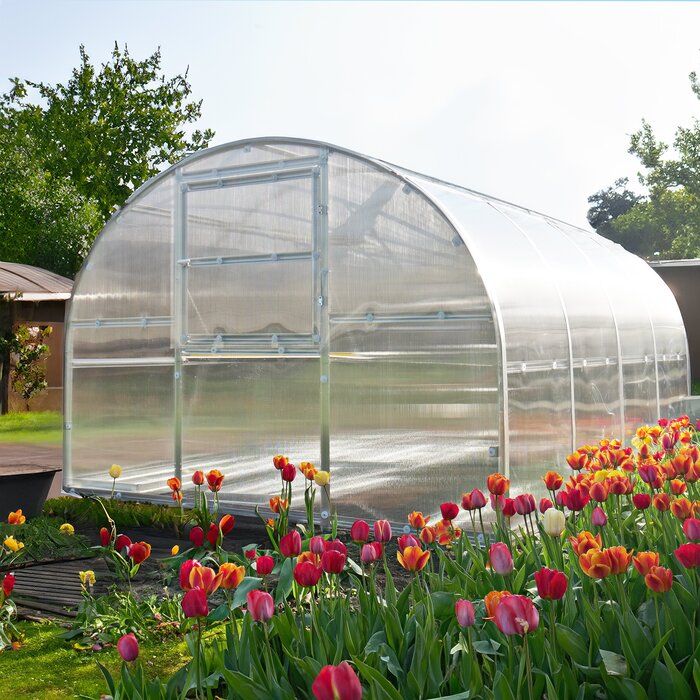
For unheated season extension
High Tunnel Greenhouse
A tunnel of zinc-coated steel arches under 6 mm UV-protected polycarbonate, in 5 sizes from 129 to 388 sq ft, with two side windows and one end door. If those panels are twin-wall, published figures for 6 mm twin-wall put light at about 80%, which suits unheated growing; ask Bloomcabin which wall type they are.
Retailer feed of
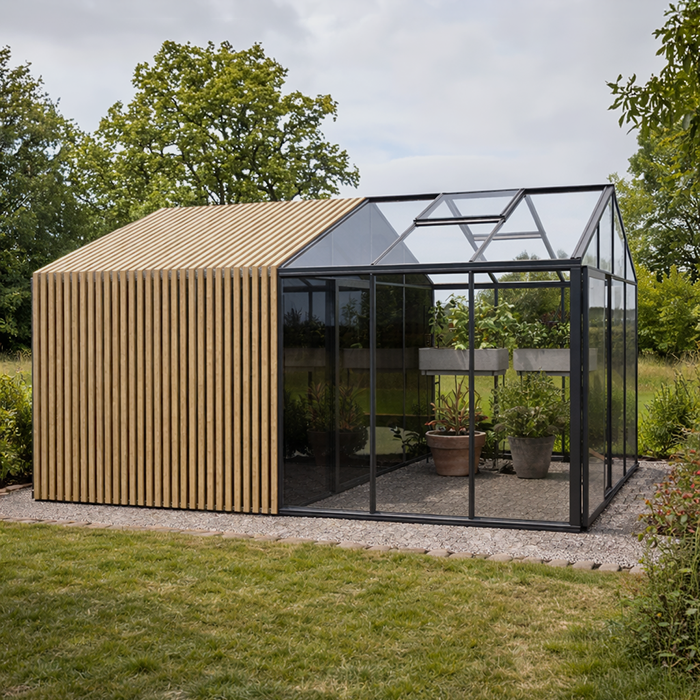
For a finished garden building with a storage end
Limited Edition Greenhouse with Built-In Storage
An aluminum greenhouse with a storage section and Accoya wood details, offered with either polycarbonate or tempered safety glass. The page lists roof vents, a built-in aluminum base and ratings of 67 mph wind and 43 lb/ft² snow.
Retailer feed of
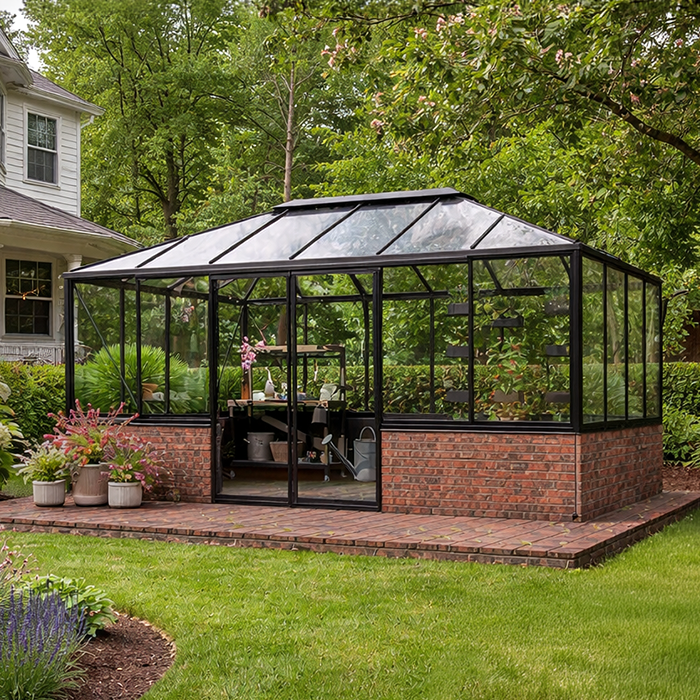
For a greenhouse on a brick or stone base you build
Pyramid Greenhouse for Wall Bases
An aluminum pyramid-roof greenhouse built to sit on a wall or stone base that the buyer builds, with glass or polycarbonate panels. The page gives six sizes from about 60 to 153 sq ft.
Retailer feed of
Retailers to browse
Compare sizes, materials and delivery details on each retailer’s current listings.
- Go to Bloomcabin
Bloomcabin
Opens Bloomcabin’s store (greenhouses, garden houses and pergolas).
- Browse greenhouses at Veikous
Veikous
Opens Veikous’s greenhouses collection, not a single product.
Written from manufacturer and retailer information and general garden practice. GardenHelm has not physically tested the products discussed here. How we choose products