Pergola With Vines: Choose Plants, Supports and a Manageable Canopy
Summer shade, flowers at eye level, fruit or just greenery? The goal decides the vine, and the vine decides the support. Leave yourself a way to train and prune it.
By GardenHelmPublished 6-minute readMore in Pergolas & Covered Terraces
In this guide
We may earn a commission from links on this page, at no extra cost to you. How this works
Oregon State’s extension horticulturist gives wisteria growers one instruction before any other: provide the strongest support you can, because the plant gains weight quickly (OSU Extension on wisteria pruning). That sentence is the whole planning problem in miniature. A pergola with vines is a structure and a plant growing into each other for decades, so the vine you choose decides how strong the frame must be, how you will reach the top of it, and how many weekends a year you spend with pruners.
Start with the job. Shade over a dining table calls for overhead coverage and a vine that thrives on a roof of beams. Flowers beside a doorway can come from a single accessible climber on one post. Grapes for eating want sun and a training system built for fruit, and greenery along one side needs only a compatible surface and room to spread. These goals lead to different plants, so settle which one matters most before you fall for a flower color. The outdoor structures hub covers the frame side of the decision.
Plants worth considering, and what each one costs you
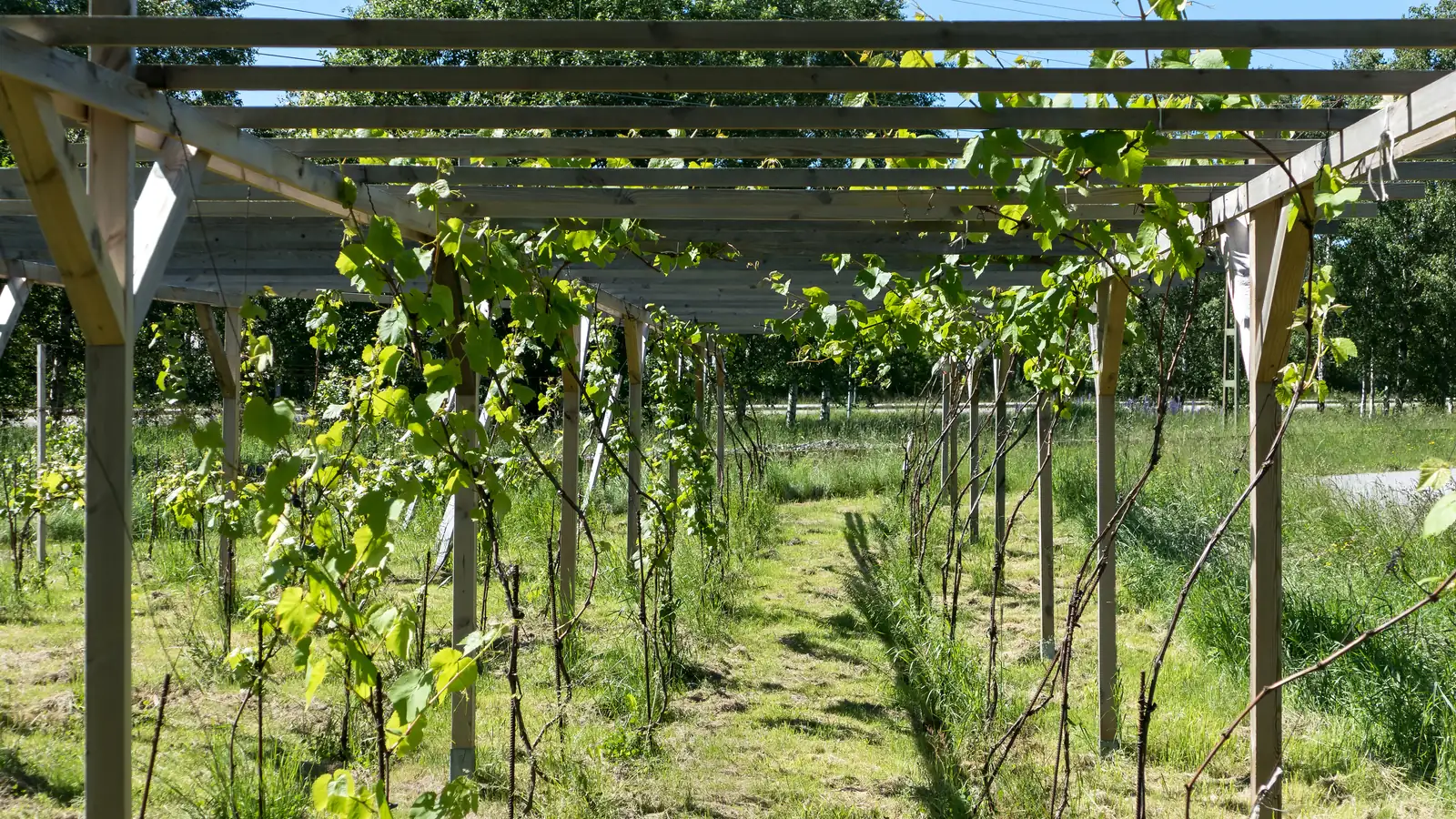
Grapes. University of Minnesota Extension says grapevines become heavy and need sturdy support, and it separates growing them over an arbor for shade from managing them on a sunlit trellis for quality fruit. Decide which you want first, because the pruning and training differ. For northern gardens it names Bluebell as a hardy juice-and-jelly grape that does well in USDA zone 4 and is also suitable in zone 3, which is a regional example, so use a variety your local extension office recommends. Overhead fruit also means you will harvest above your head and sweep up what falls, so leave room to reach the vine and to clear the seating below (Minnesota grape guide).
Wisteria. Treat it as a commitment. OSU Extension recommends pruning twice a year. In winter, cut excess growth back to the trunk and shorten the remaining runners to two or three buds, about 6 inches. In summer, remove excess growth again and clip the rest to two or three buds. American wisteria (Wisteria frutescens) is the native option. NC State describes it as less aggressive than Chinese wisteria but still able to reach 40 feet or more, hardy in zones 5a to 9b, and needing sturdy support, sun and continuing pruning (NC State profile). Buy it by botanical name, because an unlabeled wisteria could be one of the Asian species, and look up your state’s invasive plant list before planting any wisteria. NC State rates American wisteria as moderately toxic to people, with the seeds and pods the main hazard, and it lists risks for cats and dogs too, so keep children and pets away from the pods.
Trumpet vine. The University of Florida’s publication on Campsis radicans says the plant can climb 30 feet or more, needs regular pinching and pruning to establish on a structure, and has an aggressive habit that makes it hard to remove once established. It adds that the thick woody stems can grow between wooden siding and destroy it, and that the vine is best suited to the base of an arbor or trellis (UF/IFAS). Hummingbirds and other pollinators visit the orange flowers. Keep it on a freestanding pergola well away from the house.
Coral honeysuckle. Lonicera sempervirens is an eastern US native twiner that NC State lists for zones 4a to 9b, at roughly 10 to 20 feet, flowering best in full sun in moist, well-drained soil. It can stay evergreen through mild southern winters and drops its leaves in colder ones. The same profile flags high flammability, so in wildfire country consult local defensible-space guidance before placing it near a building (NC State profile).
Clematis. A good choice for a named cultivar’s flowers on an accessible post or panel. Mature size and hardiness vary by cultivar, so buy by name. The Royal Horticultural Society sorts clematis into pruning groups, with early flowers on older growth and later flowers on new growth, and the right cut depends on which group yours belongs to. Its calendar is British, so use the group logic and adapt the timing to your own climate (RHS pruning guide).
Plant Addicts’ clematis collection is one place to compare named cultivars on those terms. The cultivar pages we opened state USDA zones, mature height and whether the plant blooms on new wood, old wood or both, which is the detail that decides when you can cut it; some also name the group. Jackmanii Superba is described as group 3 at 10 to 12 feet, blooming on new wood, and Josephine as group 2 at 6 to 8 feet, blooming on both. Match the height to the post or panel you can reach and the zones to your own before choosing a flower color.
Give the vine something it can actually grip
Illinois Extension sorts climbers by how they attach: twining stems, tendrils, clinging roots and adhesive pads. Grapes use tendrils, and clematis grasps with leaf stalks (Illinois attachment guide). A tendril climber needs wire or slim lattice it can wrap, and a broad smooth post leaves it nothing to hold, so add wire or a narrow secondary support. A twiner will wind around a post but needs a way to start. Clinging vines can mark or damage wall finishes, which is one more reason to keep a heavy climber on a freestanding frame.
The thin thing a vine grips is not the load path. The ties, wires, posts, beams and footings all have to cope with the mature plant. If you are unsure about capacity, ask a qualified builder or engineer; do not size beams from a plant’s advertised height.
If the pergola has a louvered or retractable roof, growth must not reach the moving parts, and attachments should be limited to those the maker permits. A nearby trellis often delivers the planting you want without involving the roof mechanism.
Reach, training and pruning
Plan the route growth will take and keep the base accessible for watering and inspection. A narrow gap behind the furniture should not be the only way to reach the roots. Guide shoots toward the support as they develop rather than waiting for a tangle, keep the intended path in view, and loosen ties before they constrict expanding stems. A stiff woody stem should not be forced around a tight bend just to match a sketch. Planting day is the start of the work: water regularly through establishment, and tie in new growth as it appears.
Pruning follows the plant. Illinois Extension notes that needs vary by vine and warns that growth can enter gutters, vents and other openings in a building, so keep those accessible where a pergola adjoins a house (Illinois vine-care guidance). For clematis, identify the group before removing last season’s stems; for grapes, follow the training system; for a large woody vine, plan on yearly size control, since one severe cut will not fix overcrowding for good. Inspect the frame while the plant is still relatively open, including connections and finishes, and arrange repairs instead of adding ties to hide damage.
Shade, seasons and rain
Mark where you want shade and watch the sun. Low afternoon light slides under an overhead canopy, so a plant on the roof may not shade the side where you sit; the sunny side may need a vertical screen. A deciduous vine thins out after leaf fall, and one sold as evergreen in a warm region may not hold its leaves through your winter.
Coverage takes years and varies with species, starting size, light and pruning. Plant fewer, better-chosen vines instead of one per post, and base the number on mature spread. If you need shade immediately, bring in a separate shade solution while the planting develops. Foliage will never replace a waterproof roof, so plan furniture around that.
Written from manufacturer and retailer information and general garden practice. GardenHelm has not physically tested the products discussed here. How we choose products