Aluminum Pergolas: How They Compare With Wood and Vinyl, and What to Check
Aluminum, steel, wood or vinyl? How aluminum pergola kits compare on upkeep, strength, heat and cost, plus finishes, roof options and the specs to check before you buy.
By GardenHelmPublished 9-minute readMore in Pergolas & Covered Terraces
What this guide compares
- Profile thickness and post size
- Finish (powder coat) and color
- Fixed, louvered or covered roof
- Wind and snow ratings
- Anchoring and footing requirements
- Warranty terms
In this guide
We may earn a commission from links on this page, at no extra cost to you. How this works
Two louvered pergola makers give opposite storm advice. Hanso tells owners of its Master pergola to close the louvers before high winds, and quotes its 165 mph rating for the louvers fully closed (Hanso help article). StruXure’s motorized roofs do the reverse, with wind sensors that open the louvers at 60 mph to relieve pressure on the structure (StruXure on louvered roofs in summer and winter). Both can be right for their own engineering, and that is the real lesson about aluminum pergolas: the material is a good start, but the ratings, finish and operating rules of the exact kit decide whether it suits your yard.
Aluminum against wood, vinyl and steel
| Material | Strengths | Drawbacks |
|---|---|---|
| Aluminum | No rot; does not rust like steel; light parts; wide color range; takes louvered roofs | Costs more than basic wood; thin profiles feel flimsy; modern look |
| Wood (cedar, pine, redwood) | Warm, traditional; easy to cut and adapt on site | Needs stain or sealer every few years; can rot or attract insects |
| Vinyl (PVC) | Low upkeep; clean white or neutral finish | Long spans usually need internal reinforcement |
| Steel | Strongest for its size; slim profiles possible | Heavy; rusts where the coating is damaged |
Aluminum makes most sense if you want a frame you rarely have to think about, like a contemporary look, or want an adjustable louvered roof. Wood is the better buy for a traditional house, a budget build or a design you want to alter yourself. Vinyl sits between the two for a white, low-upkeep frame at a moderate price.
The finish is most of what you are buying
Bare aluminum does not rust, but it oxidizes and dulls, so almost every kit is powder coated. The coating is what you see and what weathers, and coatings are not equal. Architectural powder coatings are graded against AAMA standards: as Finishing and Coating summarizes them, AAMA 2603, 2604 and 2605 call for 1, 5 and 10 years of Florida exposure respectively. Pergola listings do not always state an AAMA grade. If one does, 2604 or 2605 is a meaningful promise about fading and chalking; if it does not, the warranty’s wording on fading, peeling and corrosion is your best guide.
Near the coast or a salt-chlorinated pool, look harder. Look for stainless steel fasteners, which resist corrosion better than plain or zinc-plated steel, and touch up chips promptly so moisture cannot creep under the coating. Rinse off salt deposits as the maker recommends.
Color has a practical side. Dark finishes absorb more sun and get hot to the touch, which matters little on posts and more on a low roof over your head on a summer afternoon. Light colors stay cooler and show less dust; charcoal and black hide dirt and suit modern houses. To match window frames, look for a maker that lists RAL colors (a standard color system) rather than a short fixed palette. Bloomcabin sells its freestanding Aluminum Pergola in a wide range of RAL colors, which makes it the practical route when the frame has to match existing windows or a door color exactly.
Frame size and span
Two “aluminum” pergolas can feel completely different. Compare post size (for example, 4 or 5 inches square), beam depth and wall thickness, which listings often omit and suppliers will usually give on request. Long spans without a center post need deeper beams, so if you are buying a large size, read the wind and snow ratings for that size, not the smallest one in the range.
The two makers linked here show how uneven the published detail is. Bloomcabin’s pergola pages describe “heavy-duty profiles” and list sizes and an overall height, but give no post size, wall thickness, coating grade or wind and snow ratings. Pergolux’s Standard S3 page links a load calculation giving 150 mph of wind for every size and 30 to 50 lb per sq ft of snow depending on size. The missing figures do not show the Bloomcabin frame is weaker; they mean the Bloomcabin quote should come with those figures for your size before you compare the two on strength.
Hanso’s listings add one more field to ask every seller about: the alloy temper. Its hand-cranked Aluminum Pergola Kit is described as 6063-T5 aluminum with a three-layer powder coat and reinforced aluminum baseplates, rated for 120 mph of wind and 25 psf of snow. Set beside the Standard S3, the other crank roof on this page, both figures sit below the S3 sheet’s 150 mph and 30 to 50 psf, so for a snowy or exposed yard the S3 is the one whose published loads reach further. Hanso’s motorized Horizon Smart Pergola moves up to T6 aluminum, 165 mph with the louvers closed and 60 psf, with stainless steel baseplates. Each description quotes one figure per model, so ask Hanso which size and mounting it was certified for before comparing it with a size-by-size sheet.
Louvered roofs: what the rating assumes
Aluminum frames take several roofs: fixed slats for partial shade, solid or polycarbonate panels for rain cover, sliding fabric canopies, and adjustable louvers turned by a crank or a motor. Our guide to pergolas with a roof compares them in more detail. A fixed-slat frame costs far less than a louvered one, so buy louvers only if you want to switch between sun, shade and rain cover.
For any louvered roof, the listing or manual should answer these:
- Which louver position the wind rating assumes, and what the manual tells you to do before a storm. As the two makers above show, there is no universal answer.
- What to do in snow. Hanso advises opening its louvers slightly in heavy snow so melting snow falls through; StruXure recommends keeping its louvers open in heavy snowfall so snow falls through. Snow ratings, like wind ratings, are quoted for a particular position.
- Where the water goes. Closed louvers channel rain into gutters and down the posts. Find out where the downspouts discharge and keep that away from doors and walking routes.
- What happens when the power fails, for motorized roofs, and who services the motor and controls.
Pergolux’s Series 3 puts the crank-or-motor question on one frame family. The Standard S3 is turned with a hand crank, so the roof needs no power supply. The Sundream S3 is listed with thicker aluminum and replaces the crank with an electric roof, adding integrated lighting and a gutter system, controlled from a phone over Bluetooth, through smart-home integration or from a water-resistant controller. On a patio used mostly at weekends, with the louvers left open for most of the summer, the crank has nothing to run and no controller to replace. Where the roof will open and close daily, or should close from indoors when a shower arrives, the motor is what the extra money buys, together with the power-failure question above. What it does not buy is a higher rating on paper: the Sundream’s own load calculation gives the same 150 mph of wind and the same 30 to 50 psf snow range, varying by size and mounting, so read the line for your size on either sheet.
Footings and anchoring
A wind rating only holds if the posts are anchored the way the manual specifies, usually either concrete footings sized for your soil and frost depth, or bolts into a concrete slab of a stated minimum thickness. Pavers and wooden decks are rarely enough on their own. Read the installation manual before you buy so you know which you need, and if you get snow, ask your building department for the design snow load at your address and compare it with the kit’s rating. A louvered roof that catches wind puts real uplift on its anchors.
A wall-mounted version saves two posts and suits a patio door, but it has to be fixed into the structure behind the siding with the joint flashed against water, and attached structures are more likely to need a permit. Lights, heaters and motorized roofs also mean electrical work, which needs a licensed electrician and whatever permit your area requires.
Height is the other test a wall-mounted kit has to pass, because the beam must fit between the top of the door and the eave. Bloomcabin’s wall-mounted version gives an overall height of 98.4 inches (about 8 ft 2 in) in its specification box and 255 cm (about 8 ft 4 in) further down the same page, so ask which figure applies to your order before measuring it against your wall.
The kits linked on this page
More frames are in the pergolas category. These picks come from retailers we have affiliate relationships with, so GardenHelm may earn a commission if you buy through them. Descriptions are based on the retailers’ published product information, not on our own testing. Prices shown start at the smallest configuration, and ratings vary by size, so read the exact model’s page.
- Crank-operated louvered roof. The simplest way into adjustable shade: you turn it by hand, so the roof itself needs no power supply. The trade-off is that you must be home to close it ahead of a storm. Lights or heaters would still need wiring.
- Motorized roof with gutters and lighting. The most feature-heavy of the four, and so the one with the most that can fail: roof, lights and gutters all depend on one electrical installation. Work out who services the motor and controller, and how the roof behaves in an outage, before choosing it over the crank.
- Freestanding, in a wide size range. The flexible choice for a lawn or a patio with no wall to use, with roughly 97 to 258 square feet to choose from. It stands on its own posts, so the footings in the manual do all the work, and longer spans at the top of the range need the ratings for that size, not the smallest.
- Attached to the house wall. The same design hung off the house, which saves two posts and puts the shade right at the patio door. Everything then depends on the wall connection and flashing, so have the wall assessed first; outdoor structures covers freestanding alternatives if the wall is not up to it.
Narrow your choice to two or three kits, then send each seller the same three questions: the ratings for your exact size, the louver position those ratings assume, and the footing the manual requires. The answers, more than the photos, will separate the kits.
The picks
Chosen from the retailer’s listed specifications. Prices and availability update from the retailer feed.

Hand-cranked louvers, no motor
Standard S3 Pergola
The roof is adjusted with a hand crank, so there is no motor or wiring to plan for, and the listing says it opens for sun or closes for shade. Smart control is offered only for accessories such as lighting and heating, not for the roof itself. The load calculation linked from its page gives 150 mph of wind for every size and 30 to 50 psf of snow depending on size, and the page states a 10-year warranty.
Retailer feed of

Electric roof for hands-off adjustment
Sundream S3 Pergola
Listed with thicker aluminum, an electric roof, integrated lighting and a gutter system. It runs from a phone over Bluetooth, through smart-home integration or from a water-resistant controller. The step up from the crank model when the roof should move without anyone turning a handle. Its load calculation gives the same 150 mph of wind and 30 to 50 psf of snow, by size and mounting, so the motor does not buy a higher rating.
Retailer feed of
Freestanding frame in many sizes
Aluminum Pergola
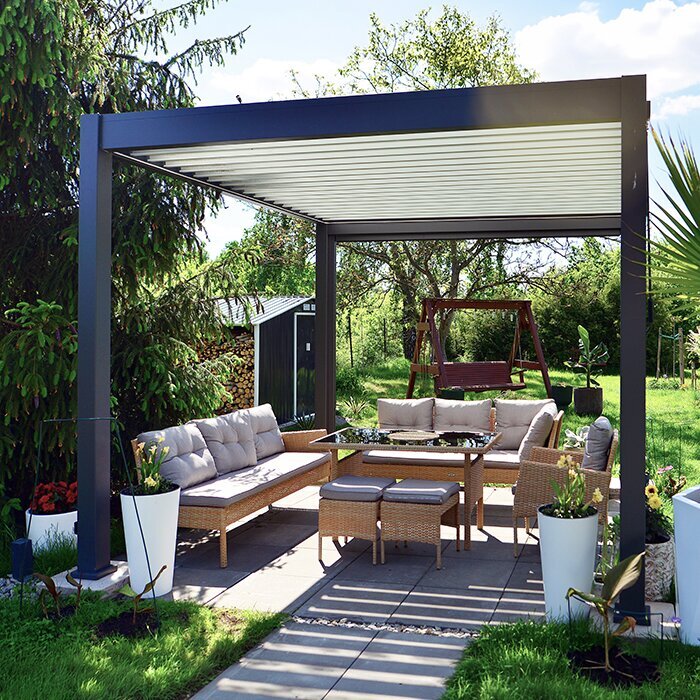
Coverage runs from 97 to 258 sq ft, so one design fits a compact patio or a larger yard, with a wide range of RAL colors to match the house. The aluminum profiles are described as needing minimal maintenance. The description does not name a roof type, so ask Bloomcabin whether the roof in the photos is included before comparing its price with the louvered kits.
Retailer feed of
Attached to the house wall
Wall-Mounted Aluminum Pergola
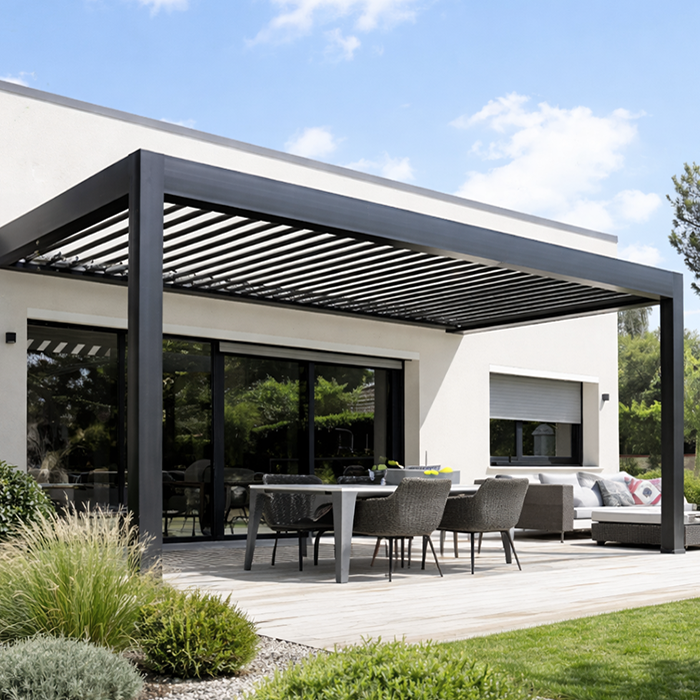
Fixed to the building wall, which the listing says gives stability and makes efficient use of space. It suits patios, balconies and relaxation areas next to the home. The aluminum construction and 97 to 258 sq ft range match the freestanding model.
Retailer feed of
Retailers to browse
Compare sizes, materials and delivery details on each retailer’s current listings.
- Go to Pergolux
Pergolux
Opens Pergolux’s store (pergola kits).
- Browse pergolas at Hanso Home
Hanso Home
Opens Hanso Home’s pergolas collection, not a single product.
- Browse pergolas at Veikous
Veikous
Opens Veikous’s pergolas collection, not a single product.
Written from manufacturer and retailer information and general garden practice. GardenHelm has not physically tested the products discussed here. How we choose products