Pergolas with a Roof: Louvered, Solid and Fabric Options Compared
How louvered, solid, polycarbonate and fabric pergola roofs differ in rain cover, light, snow load and upkeep, plus permits and what to check before buying a roofed kit.
By GardenHelmPublished 6-minute readMore in Pergolas & Covered Terraces
What this guide compares
- How much rain and sun the roof actually stops
- Wind and snow ratings for your area
- Drainage and gutters
- Freestanding or attached to the house
- Permits and footings
- Upkeep and moving parts
In this guide
We may earn a commission from links on this page, at no extra cost to you. How this works
A classic pergola has an open top: beams and rafters that give dappled shade but let rain straight through. A pergola with a roof adds a covering that stops sun, rain or both. Which roof you choose decides how often you can actually use the space, so start there, then check the structure, drainage and paperwork.
Compare what the roof is designed to do
| Roof type | Choose it for | Ask the seller for |
|---|---|---|
| Adjustable louvers | Opening the roof on nice days and closing it for rain | How it drains and which louver position it needs in wind or snow |
| Solid metal hardtop | Dependable shade and rain cover | The support and attachment design; heat and noise figures if those matter to you |
| Polycarbonate | Rain cover that still lets light through | The exact panel and color, installation details and care instructions |
| Fabric canopy | Seasonal shade at a lower cost | Whether it is rated for rain, and when it must be retracted |
Adjustable louvers
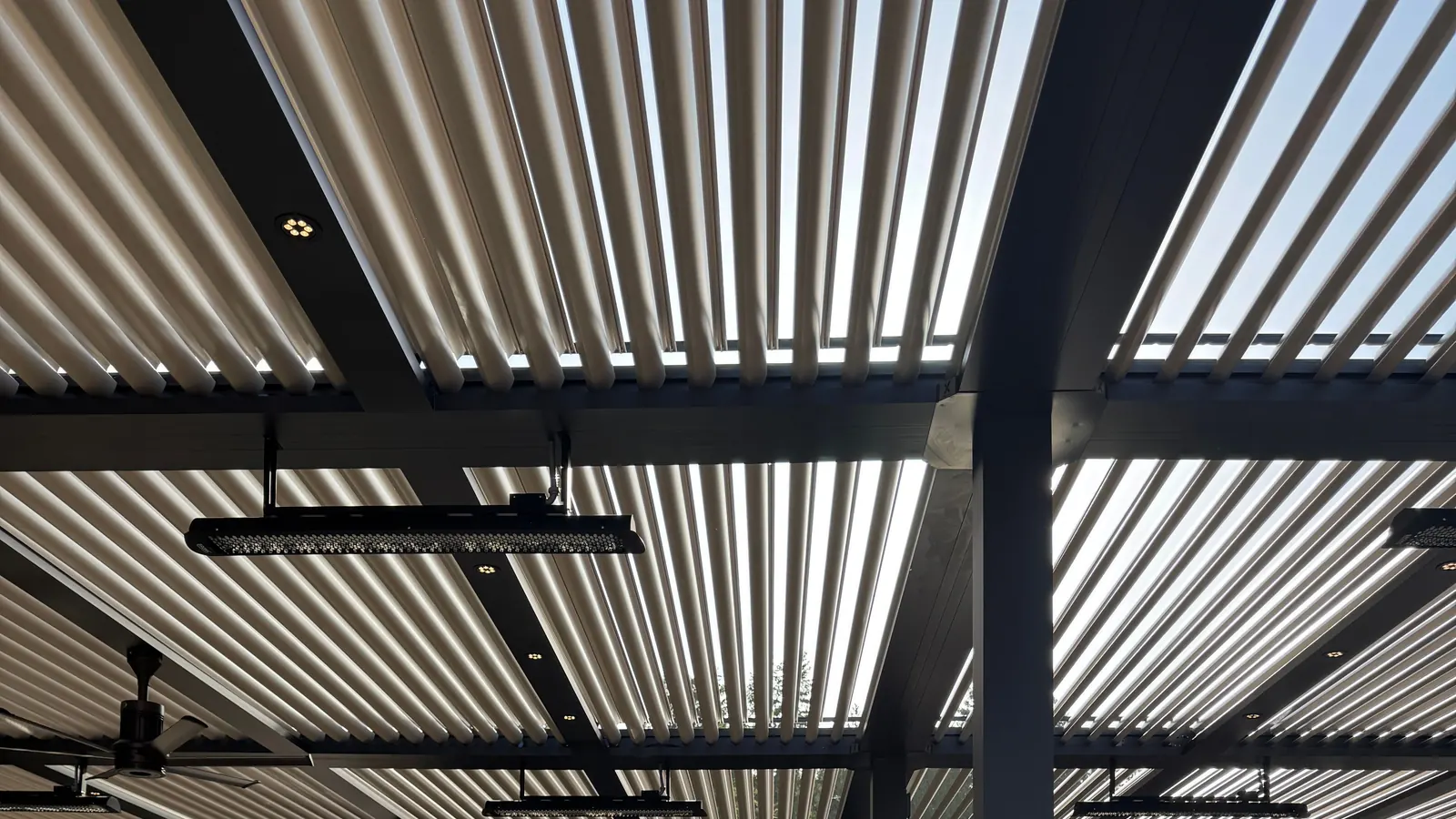
Louvers give you the most control: open for sun and air, closed for rain. Ask how the chosen model drains when closed and which position it needs in high wind or snow. They are often the priciest roof, but compare complete quotes for your size and installation before assuming so.
Two louvered systems on this page are built around different plans. Pergolux sells one frame family in steps, from a hand-cranked roof to motorized versions with more snow capacity (the ratings section below sets them side by side). Bloomcabin’s Bioclimatic Aluminum Pergola is one design that grows with options: the roof and side elements can be automated, and the listing names screens, LED lighting, side panels and glass walls as add-ons, in a choice of RAL colors. That suits a patio you mean to close in by stages with one supplier. Its product page gives no wind or snow ratings, though, so before it can be weighed against the Pergolux numbers, Bloomcabin has to put the figures for your size in writing.
Opaque hardtops
A solid roof gives the most reliable shade and keeps off overhead rain, though wind can still drive it in at the sides, at the cost of a darker space underneath and, next to the house, darker rooms behind it. How hot or loud it is in summer depends on the whole roof assembly, not just the word “metal,” so ask for specifications if comfort or rain noise matters to you.
Polycarbonate
Palram’s SUNTUF information lists different light transmission for its colors and finishes. So “polycarbonate” alone does not tell you how bright the space will be: a clear panel and a tinted one feel very different underneath. Follow the installation details for the exact panel; corrugated and multiwall sheets go up differently.
Fabric
Fabric is usually the lightest and often the least expensive way to add shade, and many canopies retract. A shade fabric is a different product from a canopy system rated for rain: a water-resistant fabric still needs a way to shed water and limits on when it can stay extended. Read the system’s instructions on wind, rain and snow.
Check the ratings for your climate
A roof catches wind and holds snow, so a roofed pergola carries loads an open one never does. Before you buy, find out:
- The snow load your area is designed for. Your local building department can give you the design snow load for your address. Compare it with the manufacturer’s rating for the size you’re buying, using documentation for that exact configuration.
- The wind rating and how the posts must be anchored to achieve it.
- What the posts stand on. A rating assumes a specified footing or a slab of a given thickness. A thin paver patio or an old deck may not be enough.
With your design snow load in hand, the Pergolux range sorts itself. All three fourth-generation listings quote winds up to 165 mph; the snow figure is what climbs, from up to 50 psf on the hand-cranked Pergola 4 to 65 psf on the motorized Pergola 4 Pro and 75 psf on the Pro Max, each “depending on configuration.” Where your address calls for 50 psf or less, the Pergola 4’s headline figure already reaches it, and the extra money for a Pro buys a motor and beam lighting rather than capacity. Between 50 and 65 psf the Pro is the first of the three listed that high. Above that, or over a patio too wide for a post in the middle, the Pro Max’s thicker profile is the one in range. A headline maximum may belong to a different size, so ask for the rating of your exact size and footing.
Local review can distinguish an open structure from a roofed one. For example, Prosper, Texas, requests site and construction documents for detached arbors, pergolas and patio covers, with additional design-document requirements for some materials and sizes. Your town may ask for something different, so take your plans to the local building department before work begins.
Drainage
Every roof that stops rain has to put that water somewhere. Integrated gutters that drain through the posts are tidy, but the water still comes out at the base. Make sure it runs away from the house, doesn’t pool on the patio and isn’t aimed at a neighbor’s yard. On attached pergolas, water should not run back toward the wall.
Freestanding or attached?
A freestanding pergola stands on its own four (or more) posts. An attached one hangs one side on the house, which saves posts but means the wall connection has to be right: it must fasten into the house structure, not just the siding, and keep water out of the wall. Have the attachment and flashing details reviewed for your house before ordering.
Permits and HOA rules
Rules vary widely by city and county. Size, height, distance from property lines, whether the structure is attached and whether it has a solid roof can all affect whether you need a permit. HOAs often have their own rules on materials and colors. A phone call to your building department and a look at your HOA covenants is cheaper than taking a pergola down.
Size and headroom
Measure the clearance under the lowest beam, not the peak. Then tape out the table with chairs pulled back as if people are seated and walk around it; a 10-by-10 is enough for some dining sets and tight for others. A fan or heater needs an installation the maker approves and its own clearances.
Upkeep
Follow the care schedule for the frame, finish, roof and any motor or controls, and ask about replacement parts before you buy. Palram’s SUNTUF cleaning guidance, for example, specifies mild detergent and a soft cloth and rules out abrasive cleaners. Other roofs and finishes have their own instructions. Store or retract fabric only as directed for that system.
Which roof suits you?
- You want to open and close the roof: louvers.
- You want rain cover and shade every day: a solid roof, or polycarbonate if you want to keep the light.
- You mostly want summer shade on a budget: a fabric canopy rated for your conditions.
Whichever you choose, check the snow and wind ratings for your size and footing before ordering.
If you’re still choosing the frame itself, see aluminum pergolas compared with wood and vinyl. For other covered structures, browse the pergolas category and outdoor structures.
The roofed pergolas listed here
The retailer listings below are starting points, not tested recommendations. Check the model generation, configuration, included parts, current availability and installation documents for your size, since a rating for another size or anchoring setup does not carry over.
The picks
Chosen from the retailer’s listed specifications. Prices and availability update from the retailer feed.

Hand-operated louvers, no wiring
Pergola 4
Manually adjusted louvers with no motors or wiring. Rated for up to 165 mph winds and snow loads up to 50 psf, depending on configuration, the lowest snow rating of the three Pergolux models here. Includes a 10-year warranty.
Retailer feed of

Motorized louvers with beam lighting
Pergola 4 Pro
Motorized, double-walled louvers with dimmable LED beam lighting, run by remote, app or smart-home connection. Rated for up to 165 mph winds and 65 psf snow depending on configuration, with a second accessory channel in each beam.
Retailer feed of

Longer spans without center posts
Pergola 4 Pro Max
A thicker structural profile allows longer spans without center posts, with wider louvers and integrated louver lighting. Rated for up to 165 mph winds and 75 psf snow depending on configuration, the highest of the three, with a third accessory channel.
Retailer feed of
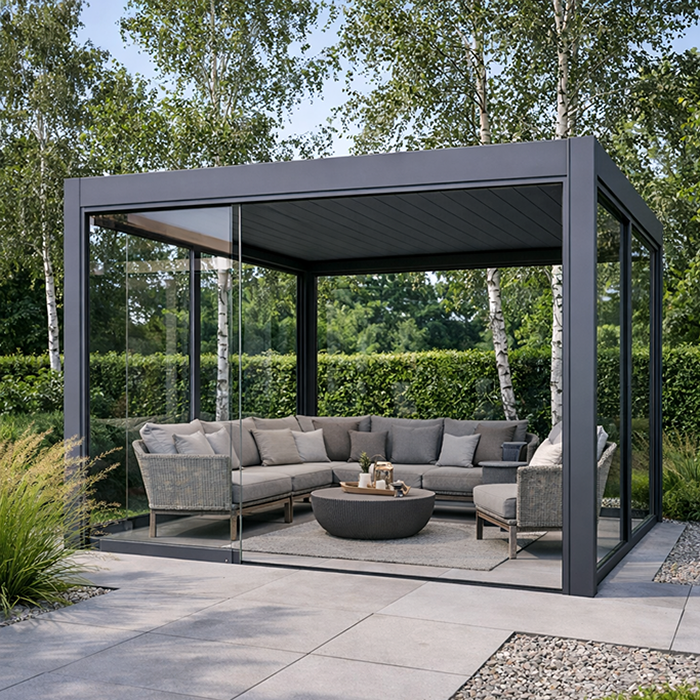
Bloomcabin louvers with optional automation
Bioclimatic Aluminum Pergola
An adjustable aluminum louvered roof that can be equipped with automated controls for the roof and side elements. Optional screens, LED lighting, side panels and glass walls are listed. Unlike the Pergolux listings, its product page gives no wind or snow ratings, so ask Bloomcabin for figures for your size.
Retailer feed of
Retailers to browse
Compare sizes, materials and delivery details on each retailer’s current listings.
- Go to Pergolux
Pergolux
Opens Pergolux’s store (pergola kits).
- Browse pergolas at Hanso Home
Hanso Home
Opens Hanso Home’s pergolas collection, not a single product.
- Browse pergolas at Veikous
Veikous
Opens Veikous’s pergolas collection, not a single product.
Written from manufacturer and retailer information and general garden practice. GardenHelm has not physically tested the products discussed here. How we choose products