Louvered Pergolas: How Adjustable Roofs Work and How to Choose One
How a louvered (bioclimatic) pergola roof opens, closes and drains, manual vs motorized louvers, rain, snow and wind behavior, sensors, spans, upkeep and what drives cost.
By GardenHelmPublished 10-minute readMore in Pergolas & Covered Terraces
What this guide compares
- Manual or motorized louvers
- How closed louvers drain
- Snow rating for your size, with louvers closed
- Wind rating and anchoring
- Span between posts
- Power, sensors and controls
- Warranty on motor and finish
In this guide
We may earn a commission from links on this page, at no extra cost to you. How this works
Read a louvered pergola’s wind rating twice, because there are two numbers hiding in it. One is how hard the wind can blow on the closed roof; the other is how hard it can blow while the blades may still be moved. On Renson’s Algarve specification sheet, for example, the roof is listed as wind resistant up to 120 km/h (about 75 mph) with the blades closed, but 50 km/h (about 31 mph) is the stated maximum wind speed when controlling the blades. Renson Algarve specification sheet Those are one maker’s figures for one model, and other makers publish different ones; the point is to find both numbers for the model you are considering.
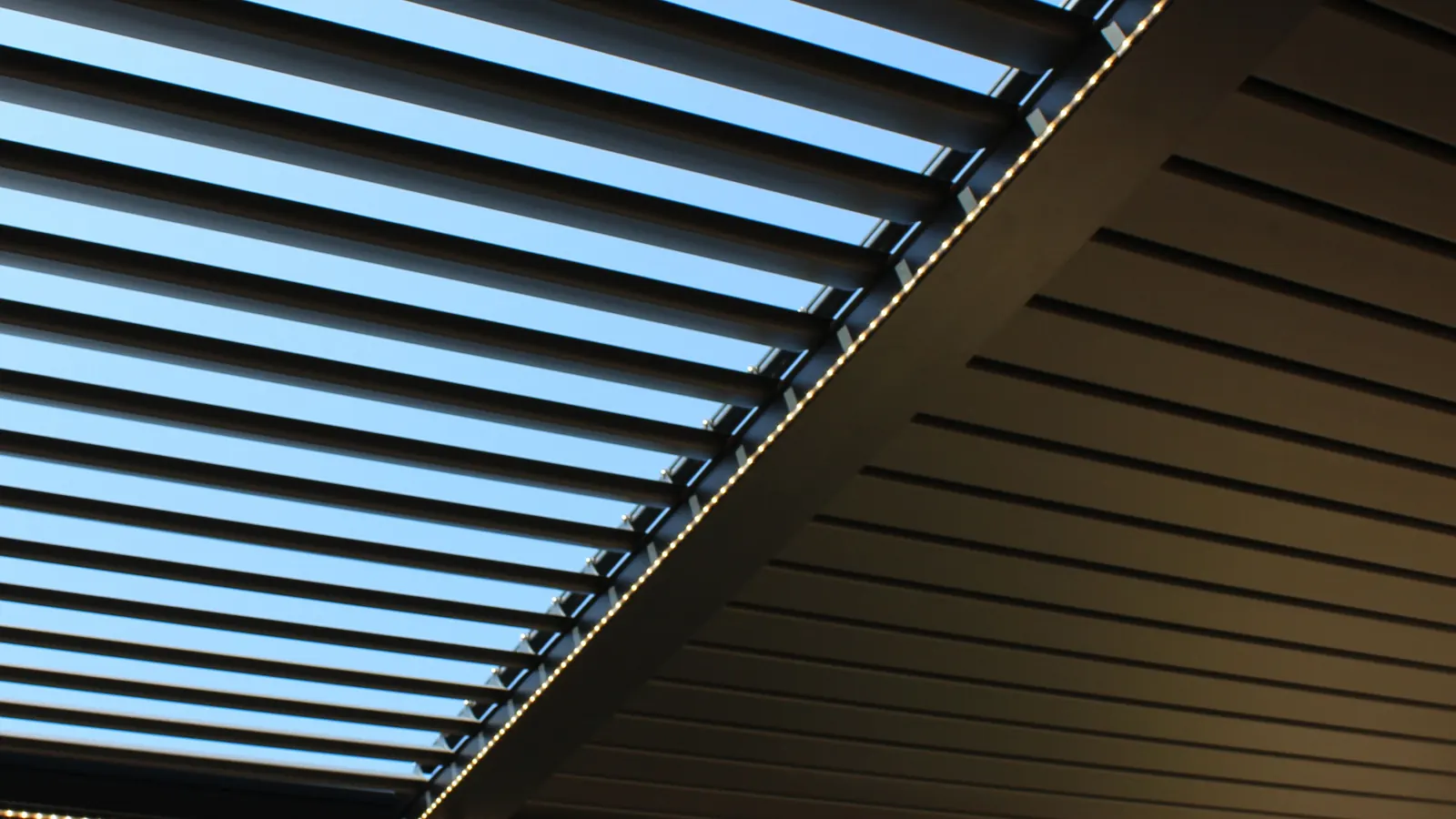
A louvered pergola, also sold as a bioclimatic pergola, has a roof of aluminum blades that rotate on pivots. Tilted open, they pass light and let hot air rise. Turned flat, they close into a roof that sends rain into gutters hidden in the frame. It is the most adjustable kind of roofed pergola and usually costs more than a fixed roof. For a choice between louvers and a solid, polycarbonate or fabric roof, start from our pergolas category; this guide stays with louvers.
How the blades move
Each blade is a hollow aluminum extrusion pivoting at both ends in the side beams, and a linkage turns them together, by crank or lever or by an electric motor in the frame. How far they turn varies: Renson lists 150 degrees for the Algarve, and StruXure says the louvers on its Pergola X rotate up to 155 degrees. StruXure, how louvered pergolas work in winter and summer A wide range lets you angle the blades away from low morning or evening sun on one side while still venting heat. Double-walled blades are stiffer; wider blades mean fewer gaps but more weight for the motor or crank.
Manual or motorized is mostly a question of how often you will go outside. A crank roof is cheaper, has no motor or controller to fail and works in a power cut, but blades tend to stay wherever they were left for days, which matters most when snow or wind arrives. A motorized roof needs a power supply run to the pergola, typically buried cable from the house, and adds a motor, controller and remote that you may have to service. Pergolux’s fourth series shows the split within one frame family: the Pergola 4 is the manual version, listed as needing no power or wiring, while the Pergola 4 Pro moves its double-walled louvers by motor and adds dimmable LED beam lighting, run by remote, app or smart-home connection. The manual roof is enough when the louvers get set a few times a season and no cable can reach the patio; the motor earns its place when the roof moves daily, or when you want to close it from indoors or by app rather than walking out to it. Warranty terms show how makers see the difference: Renson’s sheet lists a 10-year structure warranty subject to registration against 5 years on its motors and 2 years on its rain sensor. Ask a maker for the motor term next to the frame term, and how motors are replaced and stocked in the US.
What happens to the rain
A closed louvered roof manages water; it does not seal it. Water runs over and between blades into channels, then to a gutter and down a post. Renson’s sheet shows the detail worth asking about: a 50 mm (2 inch) drain hole in the gutter at each pivot side, fitted with a trap that doubles as a leaf catcher, a drainpipe inside the column, and an opening at the foot of the column. It also lists hidden L-profiles on the blade edges to stop water running back, and slightly inclined blades so water drains when you rotate them after a shower. The roof is stated to handle a shower of 120 liters per square meter per hour (roughly 4.7 inches an hour) for up to two minutes, which Renson says occurs about once in ten years by Belgian rain statistics.
Put that beside your own climate. A design storm figure gives you a sense of how much margin a gutter system has, and a heavy, wind-driven downpour can still overflow it or push water in at the sides. Good answers from a seller name where the water exits (usually at the base of one or more posts), how the blade ends are sealed against the beam, and how the leaf traps are cleaned. Plan where the discharge goes so it does not pond on the patio or run toward the house.
Snow
Snow is where louvered roofs surprise buyers. Engineering Express, an engineering firm that designs these structures, notes that the gaps between closed louvers may shed a little snow at first, but as it builds up the gaps close and the louvers carry the full load. Engineering Express, designing outdoor structures with closed louvers Heavy wet snow on a closed roof can also strain a motor if you try to open it. Many makers therefore tell owners to open the louvers when snow is forecast, at the cost of snow landing on the patio.
Snow ratings are quoted per size and configuration. Renson’s sheet gives the maximum snow load as dependent on the dimensions, and longer spans carry less. When you compare, find the rating for the exact size, whether it assumes the blades open or closed, and what footing and anchoring it assumes. Your building department can tell you the design snow load for your address; a model that cannot meet it needs an approved design solution before installation. Ask how the motor protects itself when blades are iced. Never force frozen or snow-loaded louvers.
Wind, uplift and anchoring
Wind lifts and pushes on a roof, and the blade position changes both. A rating usually describes one size, one blade position and one anchoring method, so a rating earned on concrete footings does not carry over to pavers or a deck. Follow the manual’s storm position for your model and the conditions of your local approval, not another maker’s threshold. In hurricane or strong-storm country, ask whether the model has a state or local product approval and have the anchoring reviewed by your building department.
Sensors raise the odds that the roof is in the right position when you are away. A rain sensor closes the blades when it detects rain, and a wind sensor moves them to the maker’s safe position. Both depend on power and on the system being switched on, so choose a design that still works from a basic remote or wall switch when Wi-Fi drops, and decide before winter which position the blades will rest in. Outdoor circuits for motors, lights or heaters call for a licensed electrician and may need an electrical permit.
Hanso’s Horizon Smart Pergola is a useful listing to read against those questions, because it says which blade position its wind figure assumes: 165 mph, which Hanso says was certified and tested with the louvers closed (the listing does not name the testing body or standard), alongside a 60 psf snow load. The roof tilts, opens and closes from a phone, Alexa, Google Home or Apple HomeKit, and Hanso sells a rain sensor for it separately that closes the motorized louvers at the first drops. That covers the closed-roof number from the introduction; the other number, the highest wind in which the blades may still be moved, and what the roof does when the network is down, are the two things to get from Hanso in writing.
Spans, posts and clear height
Blades must stay stiff for the roof to seal, so span matters more than on an open pergola. Renson’s Algarve, for instance, lists a maximum span of 4,500 mm (about 14 ft 9 in) per roof section and a maximum free passage height of 2,800 mm (about 9 ft 2 in), with longer roofs built by coupling sections or adding a column. Longer spans need deeper beams or intermediate posts, so check the rating for the size you want, not the smallest model. Louvers and gutters sit inside the beam depth, so measure clear height under the beams if you plan a fan or heater. A wall-mounted version saves posts but must be fixed into the house structure and sealed where it meets the wall; for footings, slabs and frame quality see our aluminum pergola guide.
Looking after it
Clear gutters and leaf traps each season, more often under trees. Rinse blades with water and mild soap and skip abrasive pads that damage powder coat; StruXure advises against chemical de-icers to protect the finish. Run the blades through their full range now and then and listen for grinding or uneven movement. Cut power to a motorized roof before cleaning blades or clearing gutters, and use a ladder that stands on its own rather than leaning on the frame. Check fasteners and post anchors once a year and after storms.
Pergola 4 or Standard S3?
The two manual roofs in the picks share most of what a buyer measures first. Both listings offer the same seven sizes, from 10 by 10 to 13 by 19 feet, freestanding or wall-mounted, in the same four finishes (anthracite, black, white, or anthracite with white louvers), and on both the roof is turned by a manual crank. The difference is in what each listing documents.
| Pergola 4 | Standard S3 | |
|---|---|---|
| Roof | Manual crank, listed as needing no power or wiring | Manual crank |
| Sizes and layouts | 7 sizes, 10 × 10 to 13 × 19 ft; freestanding or wall-mounted | Same 7 sizes and both layouts |
| Wind and snow figures | Up to 165 mph and 50 psf, depending on configuration | 150 mph for every size and 30 to 50 psf of snow depending on size, in the load calculation linked from the page |
| Walls and accessories | SnapFIT channels in the beams take walls and accessories without drilling | SnapFIT also advertised; smart control integration offered for lighting and heating |
| Warranty stated on the product page | 10 years on the structure, 5 on the finish, 2 on moving parts, with registration | 10 years headline; no breakdown on the page |
Both publish loads. On snow they top out at the same 50 psf, though the S3 calculation sheet drops to 30 to 40 psf for some sizes, so read the line for yours. The clearer gap is wind, up to 165 mph for the Pergola 4 against 150 mph for the S3, so an open, exposed site points to the Pergola 4. The other documented difference is the warranty: the Pergola 4 page splits it into structure, finish and moving parts, while the S3 page gives a 10-year headline only, so ask Pergolux for the S3’s terms in writing if that split matters to you. Either way, get the rating for your exact size and layout in writing, because the Pergola 4 page phrases its loads in more than one way and the S3 figures vary by size. What the S3 page adds is smart control for lights and heating; the Pergola 4 page lists LED lights and heaters as accessories with a remote, so if smart-home control decides it, ask whether that covers the Pergola 4 too. Neither roof moves by motor; for that, see the Pergola 4 Pro above.
Two other options sit in the picks for other briefs. The Skydance S3 is a Series 3 model the retailer describes as built in larger dimensions, with a motorized roof and lights in the louvers. Bloomcabin’s bioclimatic pergola lists automated controls, screens, LED lighting and glass walls as options, for a pergola closed in on the sides; ask either seller for wind and snow figures for your size.
What drives the cost
Size and number of bays come first, then motorization with sensors and lighting, then structure (deeper profiles, wider blades, higher snow ratings), stainless rather than plated fasteners, add-ons such as screens, glass walls and heaters, and installation: footings or slab work, electrical, permits and delivery. A manual roof in a common size with no extras sits at the low end.
The picks here are louvered aluminum pergolas from retailers we work with, described from their published product information, which we have not tested. For a mostly summer, low-snow site a manual roof is often enough, and for daily use in changeable weather, a motorized roof with a rain sensor saves the trips outside. Windy or coastal sites call for stainless fasteners, a rating given with the blades closed and anchoring done properly. For other covered structures browse the pergolas category and outdoor structures.
Where winters are cold, get the documented load rating for the exact configuration and follow its winter operating instructions.
The picks
Chosen from the retailer’s listed specifications. Prices and availability update from the retailer feed.

Manual roof, highest wind figure of the two crank models
Pergola 4
Louvers adjusted by hand, with no motor or wiring. The maker publishes up to 165 mph of wind and 50 psf of snow depending on size and configuration, so ask for the figures for yours, and its page itemizes the warranty: 10 years on the structure, 5 on the finish and 2 on moving parts, with registration.
Retailer feed of

Motorized roof with beam lighting
Pergola 4 Pro
The retailer lists motorized double-wall louvers, dimmable LED beam lighting and remote or app controls. Electrical work and installation are separate planning requirements.
Retailer feed of

Crank roof, smart control for lights and heaters
Standard S3 Pergola
The original Series 3, its roof turned by a crank, with smart control integration offered for accessories such as lighting and heating. The load calculation linked from its page gives 150 mph of wind for every size and 30 to 50 psf of snow depending on size, and the page states a 10-year warranty without breaking it down.
Retailer feed of

Larger motorized roof
Skydance S3 Pergola
A Series 3 model the retailer describes as designed in larger dimensions, with a motorized roof, lights integrated in the louvers and control by remote, Bluetooth or smart-home integration. Ask for its wind and snow figures for your size; the feed description gives none.
Retailer feed of
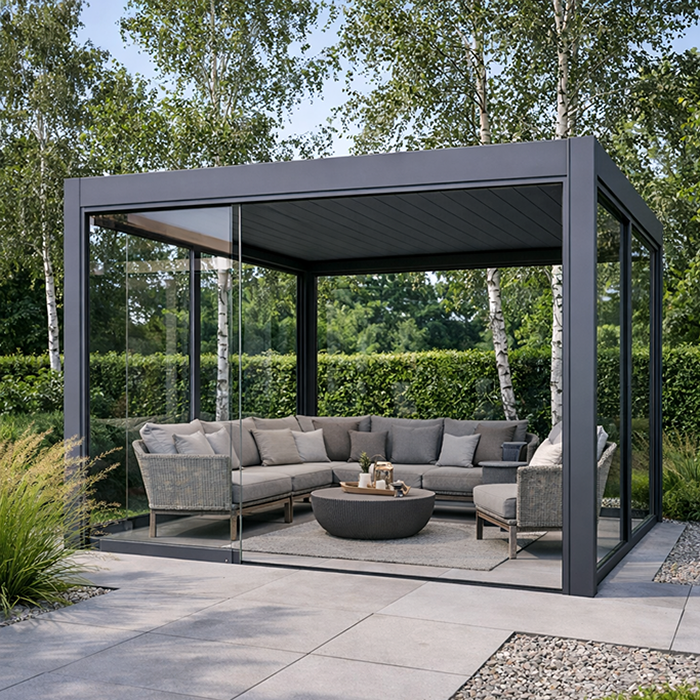
Louvered roof plus screens or glass walls
Bioclimatic Aluminum Pergola
An aluminum bioclimatic pergola whose louvered roof, according to the retailer, ventilates when open and keeps out rain and direct sun when closed. Automated controls, sun-shading screens, LED lighting, side panels and glass walls are listed as options.
Retailer feed of
Retailers to browse
Compare sizes, materials and delivery details on each retailer’s current listings.
- Go to Pergolux
Pergolux
Opens Pergolux’s store (pergola kits).
- Browse pergolas at Hanso Home
Hanso Home
Opens Hanso Home’s pergolas collection, not a single product.
Written from manufacturer and retailer information and general garden practice. GardenHelm has not physically tested the products discussed here. How we choose products