Hose Reel Cart Guide: Capacity, Wheels and Everyday Use
A reel cart is worth it when you roll the hose between watering spots. Make sure you can move it loaded, park it securely and rewind without a fight; ignore the maximum capacity.
By GardenHelmPublished 5-minute readMore in Hoses & Reels
What this guide compares
- Hose diameter and capacity compatibility
- Manageable loaded cart and suitable route
- Stable winding position and accessible crank
- Matching leader connections and replaceable parts
- Practical drainage and winter storage
In this guide
Which hose will go on it, and over what ground will you wheel it? Those two questions settle a hose reel cart faster than any capacity number printed on the box.
A cart earns its place when moving the reel solves a repeating problem: one hose shared between a front and a back faucet, a reel that lives in a shed between uses, or a rental where nothing can be screwed to the wall. If all your watering starts at one tap and the hose reaches, a stationary reel is simpler. Wheels also do not stretch the supply, since the cart can only travel as far as its leader hose reaches while connected.
Capacity depends on the hose you own
Reel capacity ratings assume a particular hose. Liberty Garden says its capacity figures are tested with standard-grade 5/8-inch hose, and that larger diameters or thicker walls reduce the length its reels accept. That is one maker’s statement about its reels, but the principle is worth carrying into any comparison: the number only means something with a diameter attached.
So start with your hose, not the reel. Note its inside diameter and wall, then compare reels at that size. Drain the hose before winding: 100 feet of 5/8-inch hose holds about 1.6 gallons, roughly 13 pounds of water, that the cart would otherwise carry. Couplings, stiff sections and uneven winding need room too, and a drum packed to the rim is a pain to wind.
Buying a much bigger reel only because its number is larger adds bulk without making the job easier. A smaller cart is poor value if the last coils will not fit. Flat and expandable hoses need a separate check, since a collapsed hose looks nothing like its working size; follow the hose maker’s storage directions as well as the reel’s.
Terrain decides two wheels or four
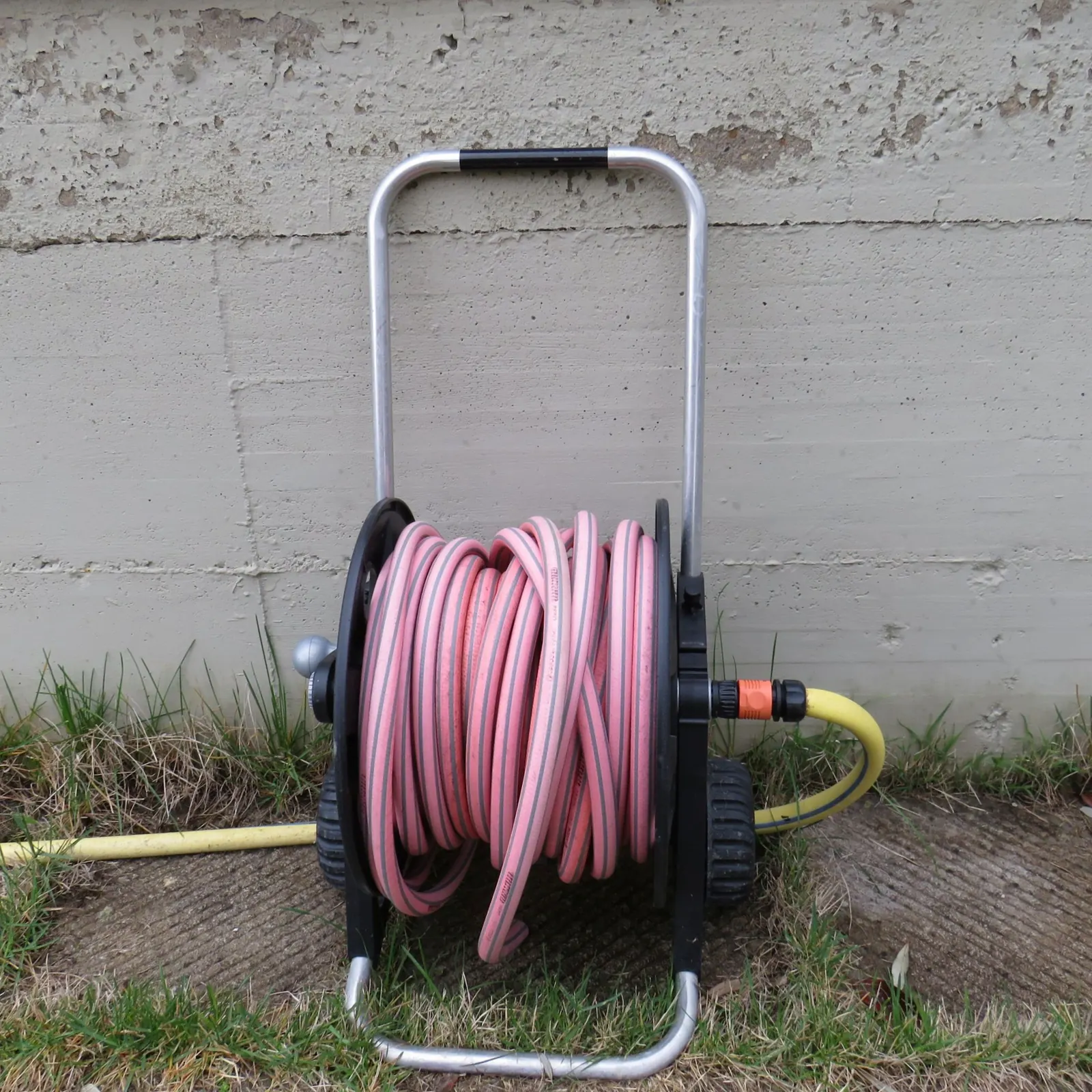
Most two-wheel carts stand on their wheels plus a front support, then tilt back onto the wheels to roll. Four-wheel carts stay level and roll on all four, with steering that varies by model. Liberty Garden’s FAQ says its two-wheel carts recline for movement, that customers who move reels often tend to prefer its four-wheel versions, and that the two-wheel design is more stable while winding. That describes Liberty’s range, not carts in general.
Think through the path the cart will take:
- Smooth patio and paved paths: either works; the four-wheel stays upright and steers from a small footprint.
- Lawn and packed dirt: wheel width and diameter matter; small, narrow wheels sink more easily, which you will feel with a full reel.
- Narrow gates and side yards: measure the loaded cart at its widest point, handle included, against the tightest opening.
- Steps, banks and slopes: be honest. A loaded cart on a slope wants to roll, and four wheels do not mean a brake. If the route includes steep or slippery ground, change where the cart lives instead of wrestling it.
A showroom test with an empty frame tells you little about the same frame loaded.
The leader hose and the swivel
Two hoses are involved. The leader runs from the faucet to the reel’s inlet, and the working hose is the long one you pull toward the plants. A swivel lets the drum rotate while the leader stays attached. Before ordering, find out whether a leader is included, how long it is, and whether its ends suit your faucet and the reel; some reels use threaded ends and others a quick-connect system, and a photo cannot tell you which adapters arrive.
Park the cart so the leader lies relaxed. It should not tug sideways on the faucet or wrap around a wheel. The Liberty 698/706 instructions show separate leader and working-hose connections, warn against overtightening and describe routing the hose around the spool end to avoid kinking; use the instructions for your own model.
Winding without a fight
Clear the path first. The crank is for winding a hose that is free to come, not for dragging a snagged one through a flower bed. Turn slowly and spread the coils across the drum; some carts have a traversing guide and others need you to steer the hose. Keep fingers clear of pinch points and stop when the hose catches, since another turn can bury a small tangle under several layers.
If the cart walks toward you or tips while you wind, stop and fix its position or the snag. Do not stand on parts that were never meant as footrests or improvise ballast. At the end of a session, shut off the supply, release pressure as the instructions direct, then rewind and secure loose ends so they cannot trail under a wheel.
Parts and winter
Ask whether the maker supplies an exploded diagram and replacement seals, swivels, leaders, crank handles and wheels for the exact model; similar appearance does not make parts interchangeable. For a leak, locate it first: faucet joint, leader, swivel or working-hose coupling. Check the washer or seal before tightening anything. Pneumatic tires need the pressure printed for that tire and cart, while solid tires have no inflation job but may ride harder on rough ground.
For winter, the Liberty manual warns against letting water freeze in the reel’s plumbing. GARDENA’s US support guidance distinguishes its AquaRoll and CleverRoll generations from 2018 onward from older reels, while still generally recommending frost-free storage, so a frost-resistant label on one range cannot be assumed for another. Pick a storage spot that fits the complete cart with handle and crank. If it must go up steps, drain and remove the hose first, since nozzles and connectors can hold water even when the hose looks empty. Clean and inspect the parts while the cart is easy to reach.
Capacity measures storage, not water pressure, so a bigger drum will not improve a weak flow; look at the supply, hose, connections and nozzle instead. For other layouts, see the irrigation guides.
Written from manufacturer and retailer information and general garden practice. GardenHelm has not physically tested the products discussed here. How we choose products