How to Choose a Hose Nozzle for Garden Watering
A row of pots at ground level and a bed across the yard need different nozzles. Choose by the watering job and control, not the number of spray patterns.
By GardenHelmPublished 5-minute readMore in Hoses & Reels
In this guide
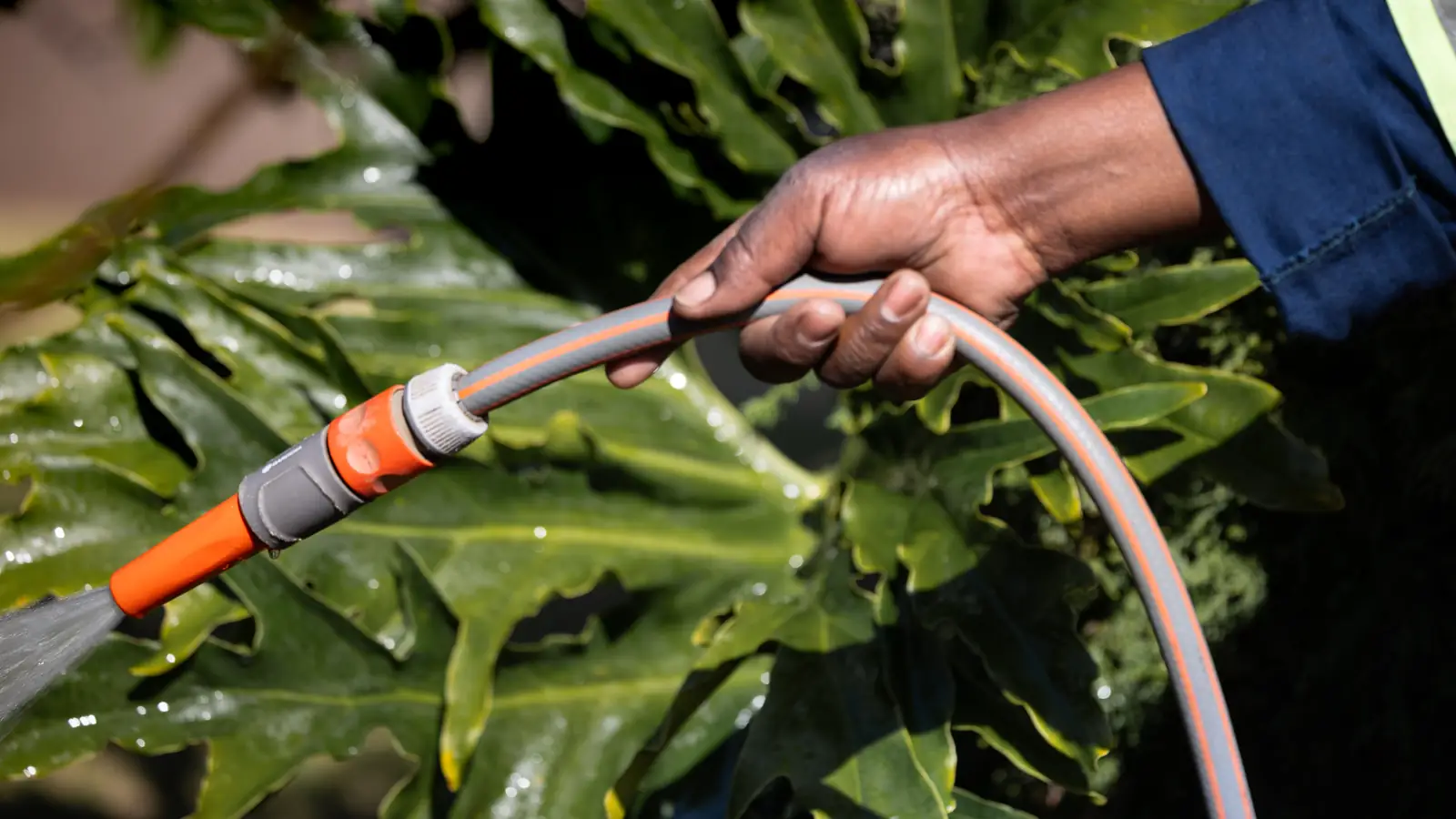
Picture the evening round: a row of terracotta pots along the patio step, a basket of petunias hanging by the door, then a vegetable bed at the far end of the hose. A pistol nozzle that blasts a narrow jet will wash soil out of the pots and leave the basket dripping over your sleeve. A soft shower head on a wand, with a valve you can close under your thumb, handles all three stops. For most plant watering, that combination of a gentle pattern and easy shutoff matters far more than how many spray settings the dial shows.
Start with where the water has to land
Walk your usual route and note the awkward spots: narrow pot openings, seedlings, crowded foliage, deep beds and anything above shoulder height. The question at each one is where your hand has to be for water to reach the soil.
University of Minnesota Extension’s watering guidance, given in its rain-barrel guide, advises watering at the base of the plant where the roots are, not splashing fruit, and avoiding overhead watering. Its main subject is rain-barrel water, which it says generally should not go on edibles. That makes two features worth paying for: a pattern soft enough to soak in, and a way to aim it low. If water runs off the surface of a pot, turn the flow down and give it time; more force usually just moves soil.
| Job | What helps | What to look for in the store |
|---|---|---|
| Patio containers | Soft shower, quick shutoff | Can you aim inside the rim without overspray? |
| Seedlings | A gentle, low flow | Can you throttle it down without a cramped grip? |
| Deep or wide beds | A wand | Does it reach the back row without you stepping in? |
| Hanging baskets | A longer wand | Can you water from below the basket? |
| Rinsing pots or tools | A jet setting | Kept separate from the shower you use on plants |
Pistol nozzle or watering wand
A handheld pistol or dial nozzle keeps the head close to your hand. It is compact, easy to store and fine for low containers and short jobs. The weak point is reach: watering the back of a bed means leaning in, and baskets mean holding your arm overhead.
A wand moves the head away from your hand and usually angles it, so you can water at soil level under foliage or reach up into a basket. The trade-off is handling. In a narrow side yard or a greenhouse aisle, a long wand knocks into things.
Dramm’s One Touch Rain Wand is a useful listing to read because it gives real numbers. Dramm lists the 16-inch model with a thumb-controlled ball valve, 3/4-inch garden hose threads (GHT) and a flow of 3.1 to 7.7 gallons per minute, and describes a lifetime guarantee to the consumer. A 30-inch version is listed separately. The 16-inch version suits containers and beds within arm’s reach; the 30-inch one is the size to consider for baskets and wide borders. Read any other listing the same way, looking for length, valve type, thread and a stated flow.
Pick the control your hand will put up with
Three mechanisms cover most nozzles. A trigger needs steady squeezing unless it has a lock clip. A thumb lever or ball valve, like the Dramm example, opens and closes with a thumb movement and stays where you leave it. A twist nozzle adjusts by turning the barrel, which is simple but often needs two hands.
If you water a long row of pots, the shutoff matters most, because you will open and close it dozens of times per round. If you wear gloves, try the control with them on before you buy. A separate flow control and pattern dial is handy when you switch between shower and jet, as long as you can read the dial without squinting.
The hose affects the feel too. A heavy, stiff hose pulls on the nozzle and tires your wrist whatever the grip.
Get the connection right
In the US and Canada, hose fittings use the garden hose thread standard (GHT, written 3/4-11.5 NH in thread designations), and the same fitting goes on 1/2-inch, 5/8-inch and 3/4-inch hoses. So the size printed on the hose describes the hose, not the thread on its end. Nozzles made for markets that use British Standard Pipe threads are the exception: BSP and GHT do not mate, and forcing them together damages the threads.
Quick-connect fittings need parts from the same system. Fittings from different brands can look identical and still fail to lock or seal. If a joint leaks, look for a missing or flattened washer first. Cranking the coupling tighter tends to crack plastic threads. Keep a few spare washers that fit your nozzle, because they are the part that wears out first.
Pressure claims and flow figures
A nozzle marketed as “high pressure” cannot raise your water pressure. It narrows the outlet into a harder stream. It does not turn a hose into a pressure washer. A flow figure means more, but only alongside its test conditions, and your own faucet, hose length and fittings decide what actually comes out.
For plants, more force rarely helps. Gilmour keeps cleaning nozzles and wands in their own category, a reminder that the jet you would use on a patio is a different tool from the shower you want on seedlings.
Repair before you replace
When a nozzle starts misbehaving, note exactly what happens: a leak at the hose joint, a leak from the body, a sticky trigger or a ragged spray. A leak at the joint is usually the washer. A crack in the body means a new nozzle.
Look for a support page or parts list for your model before you buy. Gilmour’s repair and maintenance collection shows the kind of route to look for, though a repair category does not mean every part fits every nozzle. Match the model, and do not patch a pressurized fitting with unrelated hardware.
For cleaning and winter storage, follow the maker’s directions. Poking a nail into spray holes can enlarge or burr them, and a strong cleaner that suits one product can harm another’s seals.
Settings you will actually use
A dial with nine or ten patterns sounds generous, but most plant watering uses one shower and, occasionally, a jet. Those extra settings only earn their place if you use them, for rinsing a car or misting a seed tray, say. Otherwise, choose the simplest nozzle that gives you a soft pattern, a shutoff you can work one-handed and enough reach for your farthest pot. Then judge it in use by one thing: whether the water ends up in the soil.
Written from manufacturer and retailer information and general garden practice. GardenHelm has not physically tested the products discussed here. How we choose products