Garden Stakes: Choose Plant Supports and Tie Stems Without Damage
A single tall stem, a floppy clump and a row of tomatoes need different supports. Put them in before growth hides the job, and use ties that let stems grow.
By GardenHelmPublished 4-minute readMore in Hand Tools
What this guide compares
- Support shape matched to plant growth
- Useful height after installation
- Suitable strength and anchorage
- Flexible ties and maintenance access
We may earn a commission from links on this page, at no extra cost to you. How this works
Dahlias are the plant that teaches the stake rule: put the support in at planting, before there is anything below ground to hit. Longfield Gardens, a bulb seller, advises adding dahlia supports at planting time, and one of its guides warns that waiting until the plant is about four feet tall risks damaging the tubers when the stake goes in; its guides tie stems to the stake every foot or two as they grow (dahlia support guide). The same logic applies to most plants: support goes in early, and the right kind depends on how each plant grows.
Perennials and flowers
Iowa State Extension’s staking guide separates three situations. Grids, rings and cages go on in early spring while plants are small, so stems grow through them and hide them. Peony rings, for example, go on as leaves begin to unfurl, with the hoop about half the mature height or slightly lower. Single stakes suit lilies, delphiniums and other plants with few side branches; they go in when the plant is nearly full height but before the buds open, and earlier on windy sites. Set the stake behind the plant and clear of bulbs and roots.
Ties matter as much as the stake. Iowa State recommends soft material such as cotton strips, jute or twine, tied loosely in a figure eight so the stem never touches the stake directly, with the top tie well below the flowers. Tall stems need several ties. Check them as stems thicken, and again after wind or heavy rain, when the load on a stem may have changed.
If a clump flops every year, support may be treating a symptom. The same Iowa State page lists at least six hours of direct sun, low-nitrogen fertilizing, spacing for mature size, deep infrequent watering and early pinching of stem tips as ways to avoid staking.
Peas
Peas climb by tendrils, so they want something thin to grip. Minnesota Extension says tall vines can reach about five feet and need a trellis, planted in a single row at its base, and that some shorter types can stand on their own because their tendrils tangle together. A pair of stakes with netting or string between them makes a simple trellis. Stakes alone give tendrils little to hold, so treat them as the frame the netting hangs from. Space posts closely enough that the netting cannot sag under a loaded vine.
Tomatoes
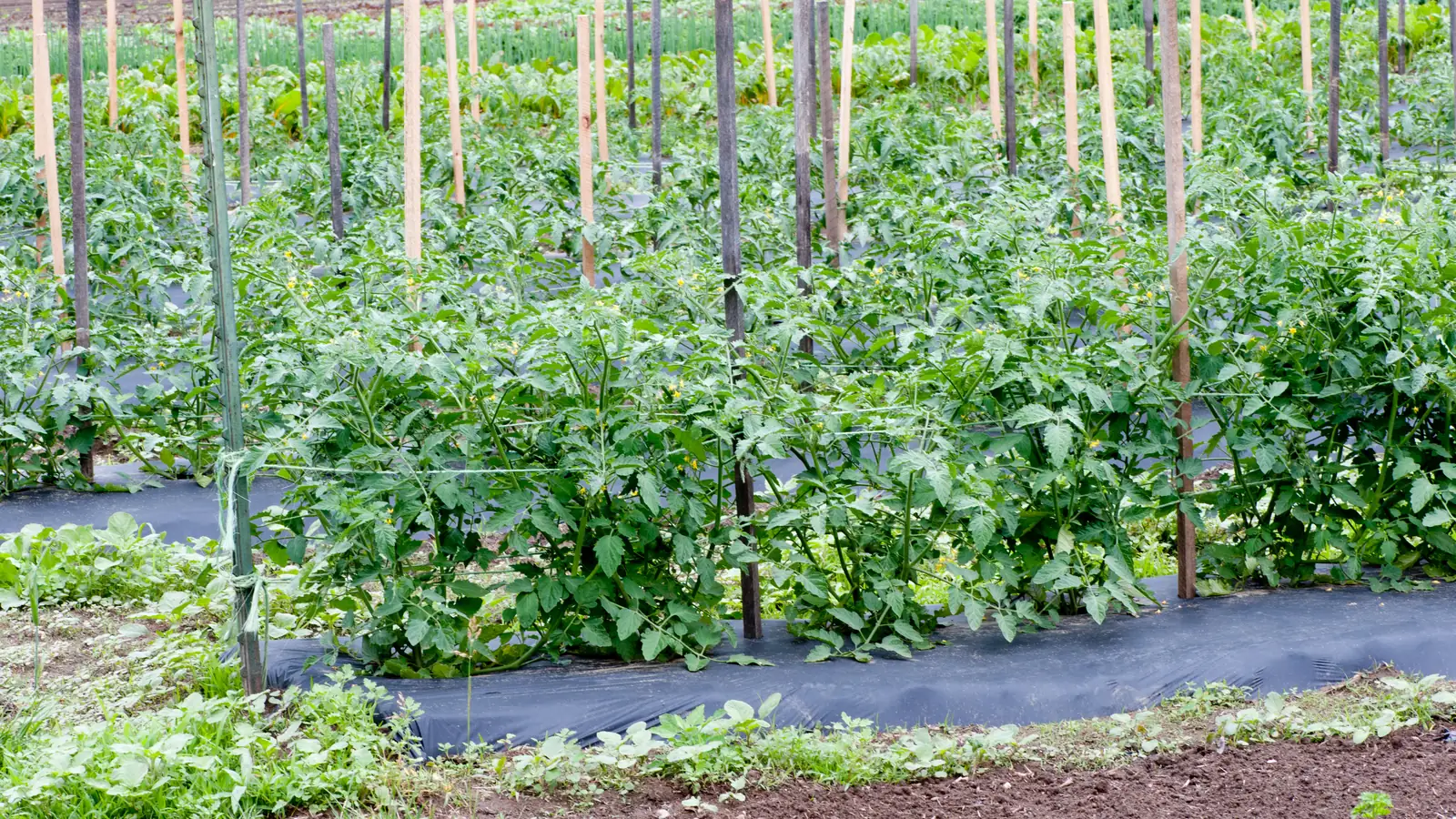
For rows, the stake-and-twine system must be planned as a unit. The University of Maryland’s tomato production guide describes a short-stake system for determinate tomatoes: stakes 4 to 4 1/2 feet long and 1 inch square, driven about 12 inches into the soil between plants, with twine woven around the stakes. A stake between every other plant is enough for most determinate varieties, an extra angled stake tied to each end stake strengthens a row, and vigorous cultivars may need larger, longer stakes. Those are commercial-field figures, so scale your expectations to a garden bed and keep the principle: sturdy ends, regular stakes, weathering-resistant twine.
Indeterminate varieties keep growing and, per the same guide, need continuous pruning of suckers and trellising. Iowa State notes that tomato cages suit tall, narrow plants when set over emerging growth. A cage is the lower-maintenance choice for a few plants; stakes and twine reward you if you will keep training them.
When comparing cages, look at two numbers: the height left above ground once the legs are in, and the thickness of the wire that has to hold a fruiting plant. The Heavy-Duty Folding Tomato Cage at Plant Addicts is described as 1/4-inch galvanized steel wire, 60 inches tall and 18 inches wide, standing about 48 inches once the legs are pushed in, and folding flat for storage; it is sold as a pack of four. Plant Addicts pitches it at tall indeterminate tomatoes, but compare that 48 inches with the height your variety is expected to reach: a determinate or compact plant usually stays within it, while an indeterminate that keeps growing past the top will need that growth tied, pinched or given a stake as well. Set cages at planting, and in loose or sandy soil push the legs deeper, as the listing itself advises.
Containers
A tall plant in a pot can tip even when the stake is firm. University of Maryland Extension discusses supports for tall and vining container crops, including installing them while plants are young and avoiding root damage. If a stake cannot be anchored in the space available, choose another arrangement instead of driving it through the bottom of a planter.
Material and safety
Bamboo and wood are easy and unobtrusive. Metal and coated-metal products offer rings, spirals and modular frames, and Iowa State notes that plastic-coated steel lasts for years and that nylon grids are hard to reuse. Inspect connectors on folding or modular frames, since small joints are where a ring fails.
Cap or otherwise protect stake tops near paths, because stakes disappear behind foliage and are hard on someone bending to weed. Before you drive anything in, locate irrigation lines and bulbs. Do not lean on supports or rest ladders against them. At season’s end, remove ties and clean and store reusable parts.
Landscape staples and tree staking are separate subjects with their own methods. For other equipment, see the hand tools collection.
Written from manufacturer and retailer information and general garden practice. GardenHelm has not physically tested the products discussed here. How we choose products