Metal Raised Garden Beds: How to Compare Panels, Coatings and Layouts
Metal beds give a vegetable garden clean lines without boards to replace. Find out what the panels and coating really are, how the walls are braced and how much soil it will take.
By GardenHelmPublished 6-minute readMore in Raised Garden Beds
What this guide compares
- Documented metal and coating
- Supported assembly configurations
- Finished edges and bracing
- Usable planting area and reach
- Replacement parts and warranty
In this guide
We may earn a commission from links on this page, at no extra cost to you. How this works
Most metal-bed listings tell you the color and the height and say almost nothing about the steel. That is the gap to close before you buy. A bed described only as “metal” or “rust resistant” could be zinc-coated steel, painted steel or something else entirely, and the difference decides how it ages, what touches your soil and what happens when a panel gets scratched.
The rest of the decision is ordinary garden planning: how wide you can reach, how deep the soil needs to be and what the filled bed will cost. Raised beds in general are covered in our raised garden bed basics; this guide stays with what is particular to metal.
What the listing should tell you about the metal
Ask for the maker’s description of the exact model. Useful answers name the base metal and the finish: galvanized (zinc-coated) steel, painted or powder-coated steel, stainless, or weathering steel that is meant to develop a rust-colored surface. A listing that cannot say which one it is has already told you something.
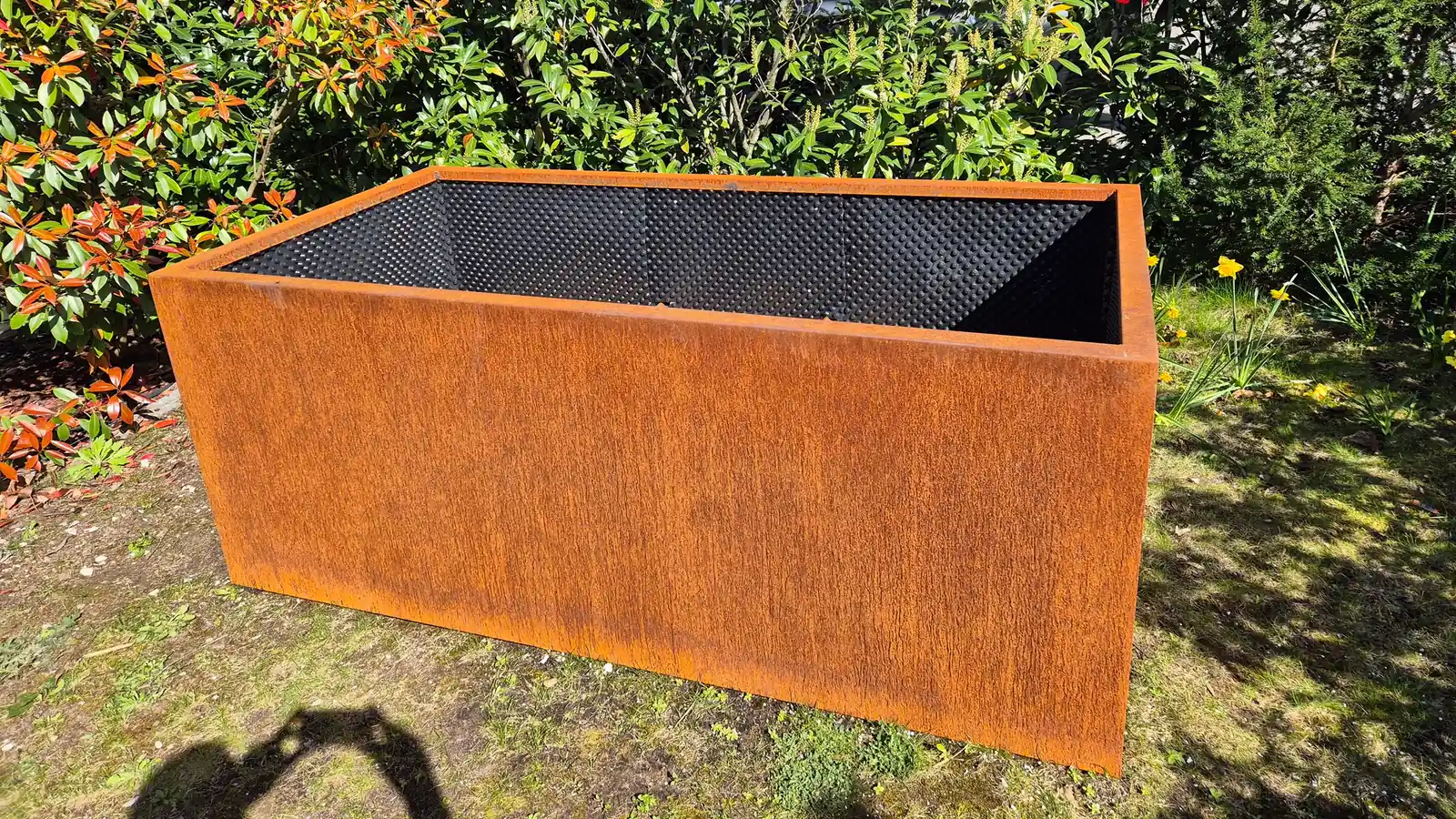
Weathering steel looks orange on purpose, but that surface can stain a paver patio or light deck beneath it. Painted and powder-coated panels depend on the coating staying intact, and a deep scratch at a corner is where trouble starts. “Rust resistant” is a claim about slowing corrosion, not ending it.
For food crops, the University of Minnesota Extension raised-bed guide discusses galvanized steel, notes that strongly acidic conditions can attack zinc coatings and cautions that some prefabricated metal beds have contained lead. Extension guidance on galvanized beds is thin and sources disagree on how acidic is too acidic, so a soil pH test is the cheapest way to see whether your mix leans acidic. If it does, ask the maker about a liner or choose another material. The working rule: buy a bed sold for growing food by a maker who documents its materials, and skip old roofing, drums or scrap of unknown history.
Look at how the walls are held up
A thin wall holds soil only because its corrugations, corners and braces work together, so thickness alone tells you little. Read the assembly instructions before ordering and find where any cross-braces sit. A brace cutting across the middle of a tall bed gets in the way of root crops and big transplants, but do not leave one out to make room. If you want a shape the kit does not list, ask the maker whether it is supported.
Check the rim too. Some kits roll the top edge; others supply a strip that covers raw cut edges. You want every exposed end covered, and you want to know how the strip attaches and whether you can replace it. Cut sheet-metal edges are sharp during assembly, so wear the protection the instructions call for. Metal in full sun can also get hot to the touch, so think twice before a bed rim becomes a seat, especially for children.
Keep spare hardware and use only the fastener the maker specifies, since an arbitrary screw in a coated panel can start corrosion at the joint. Trellises and covers need the same caution: a soil-retaining wall is not automatically an anchor for a tall, wind-catching structure.
Modular kits and the layouts you can actually build
Many kits are a set of panels you arrange as a long rectangle, a square or an L. The panel count is fixed, so each layout trades length against width. Compare the finished dimensions of each supported layout, not the number of layouts advertised.
Mark the footprint on the ground with stakes and string, then walk around it with a wheelbarrow. University of Maryland Extension describes raised beds as commonly 2 to 4 feet wide and stresses working from the paths so the soil is never compacted by footsteps. Maryland raised-bed guide If only one side is reachable, the narrow end of that range is the safer width.
Veikous’s 9-in-1 metal raised garden bed shows what a modular listing looks like. Its page answers the metal question better than most: 0.025-inch galvanized steel with a reflective coating, rubber strips over the edges and an open bottom. Its FAQ adds that the kit has four rounded corner panels and builds one bed, so the nine layouts are nine shapes of a single bed, and the rounded corners will hold a little less than the rectangle arithmetic further down suggests. Before choosing, get the finished length and width of the layout you want and check that it fits the reach you marked out with string; the description text does not list them, so ask Veikous if the product photos do not show them. The height is the bigger cost decision. For the same layout, the 23.1-inch walls take about twice the soil of the 11.1-inch ones, and the FAQ says only the 23.1-inch version comes with aluminum inner stabilizing bars, so that is the one where brace positions matter for planting. The tall walls pay off for a gardener who cannot kneel or for a bed set over poor or compacted ground; over decent soil worked from a kneeling pad, the bottomless frame lets roots go down and the 11.1-inch walls are enough, with no braces in the way and the middle within reach. Stock has varied by color and height, so check the option you want on the product page. We have not tested it or verified the seller’s durability claims. The Veikous collection is an affiliate link, and GardenHelm may earn a commission at no cost to you.
Height, floors and decks
Taller walls cut bending but add fill, and a very tall wall can put the middle of the bed out of reach even when the width is fine. Try reaching across something at the height you are considering.
Also separate two products that look alike. A bottomless frame sits on the ground and lets roots go down into the soil beneath. A planter with a floor and legs has only the soil inside it and needs working drainage. Setting a bottomless frame on a deck does not make it a planter, and a filled bed is heavy. On a deck or balcony, confirm what the structure can carry and where drainage water will go before you fill anything.
How much soil it will take
Multiply interior length by interior width by fill depth, all in feet, for cubic feet, and divide by 27 for cubic yards. A true 4 by 8 foot interior filled a foot deep holds 32 cubic feet, about 1.19 cubic yards; at 18 inches it holds 48 cubic feet, about 1.78 cubic yards. Rounded ends and internal dividers change the arithmetic, and the soil level sits below the rim, so measure to where the soil will actually end.
Get a delivery price and a drop spot before you commit. A cheap kit can turn expensive once you add bulk soil, paths and a way to water. Iowa State Extension advises a level site with water close by, and a bed you dread watering is a bed that fails.
Build on level ground, and check the frame for square corners and firmly seated braces while it is empty. A twisted frame is easy to correct then and nearly impossible once filled.
Liner, wood or metal
Whether a metal bed needs a liner depends on the product. A side liner, a weed barrier and a waterproof base do three different jobs, and blocking drainage with the wrong one causes more trouble than it solves. Follow the kit’s instructions.
Against wood, metal wins on not rotting and loses on being harder to modify or repair locally. Each season, look for loose fasteners, shifted edge strips, bowing walls and chipped coating. Touch up only with a product the maker names when the bed sits next to edible crops.
Retailers to browse
Compare sizes, materials and delivery details on each retailer’s current listings.
- Browse raised garden beds at Veikous
Veikous
Opens Veikous’s raised garden beds collection, not a single product.
Written from manufacturer and retailer information and general garden practice. GardenHelm has not physically tested the products discussed here. How we choose products