Greenhouse Heaters: Size the Heat Requirement Before Choosing Equipment
Size the heater for the heat your greenhouse loses on a cold night, not its floor area. Write a heating brief, compare electric and fuel-fired options and plan for a power cut.
By GardenHelmPublished 8-minute readMore in Greenhouses
What this guide compares
- Heat loss at the local winter design condition
- Temperature required by the plants
- Electrical or fuel supply
- Equipment suitability for greenhouse conditions
- Controls and backup arrangements
In this guide
A 1,500-watt plug-in heater puts out about 5,100 Btu per hour (watts times 3.413). Whether that holds a greenhouse above freezing depends on how many square feet of cover the greenhouse has, what the cover is made of and how cold the night gets. Floor area barely enters into it, which is why a coverage figure on a heater box is a starting question rather than an answer.
The sizing method is simple enough to run yourself. This page covers the method, a short brief to fill in, how electric and fuel-fired heaters compare, the safety rules for each, and a plan for a power cut.
Size from heat loss
Heat leaves through the roof and walls, and with whatever air leaks out. Purdue’s controlled-environment agriculture notes give the conduction part as Q = U x A x ΔT: heat loss in Btu per hour equals the covering’s U value, times its surface area in square feet, times the difference between inside and outside temperature in °F. Purdue lists U values of about 0.55 for double polycarbonate, 0.70 for double polyethylene and roughly 1.2 for single polyethylene. Purdue on calculating greenhouse heating requirements That page has no value for glass. UF/IFAS (cited below) gives a rule-of-thumb transmission factor of 1.1 to 1.4 for glass, but its factors already fold in air leakage and wind, so do not mix them with Purdue’s U values; pick one method and stay with it.
Two things follow from the formula. First, the temperature difference does most of the work. Holding 45°F on a 20°F night is a 25°F difference; holding 65°F is 45°F. With a double-poly cover, each square foot loses about 17.5 Btu per hour in the first case and about 31.5 in the second, so the warmer goal needs well over one and a half times the heat. Second, a better cover cuts the number directly: single to double polyethylene takes U from about 1.2 to 0.70.
Put the 1,500-watt heater beside that. At 5,100 Btu per hour and a 25°F difference, with U at 0.70, it could offset about 290 square feet of covering. That ignores air leakage, the floor and anything that makes your U worse than the textbook value, and it only applies if your cover really is double poly. Measure the roof and wall area of your own building before trusting the arithmetic.
Air exchange is the second term. Manitoba Agriculture’s archived heating and venting guide adds a natural air-exchange loss for a new double-poly house and then recommends adding 10 percent to the total for unexpected losses. Its examples are for Manitoba conditions, so take the method from it and not the numbers.
For a hobby house the steps are: pick your minimum temperature, use the coldest night you expect rather than the average, add up the covered surface area, apply the formula and add a margin. If a seller quotes a floor area, ask what outdoor temperature, indoor temperature and cover they assumed.
A heating brief to fill in
Before you compare any heater, write these six lines. They are what a supplier or installer needs, and they are the inputs to the formula above.
- Lowest temperature at plant level the plants tolerate, and whether you need frost protection only or growing temperature. Frost protection for a cool overwintering space is a much smaller job than keeping seedlings warm, and one thermostat setting will not suit mixed needs.
- Coldest outdoor night you expect, not the average.
- Covered surface area in square feet and the cover type, single or double layer.
- Electricity available: which circuit, and whether it is GFCI protected.
- Fuel and vent options, if any: gas or oil supply, a wall or roof route for a stack, and room for an air intake.
- Where the plants go if the heat fails, and the temperature at which you move them.
Electric or fuel-fired: how they compare
University of Florida Extension’s heating bulletin describes unit space heaters, normally fired with natural or bottled gas or fuel oil and using fans to move air, as a moderate investment that is easy to install. Hot-water systems, it says, are simple to install and need less maintenance than steam, but carry a significant investment cost. Infrared units heat objects rather than air, and the bulletin warns that fire can start if one is overturned or its coils touch flammable material. UF/IFAS, Heating Greenhouses
The comparison for a small greenhouse:
- Electric: a greenhouse-rated fan heater is the plug-in option. It adds no combustion gases, and its output is capped by the circuit. Several plug-in heaters on one extension cord overload it.
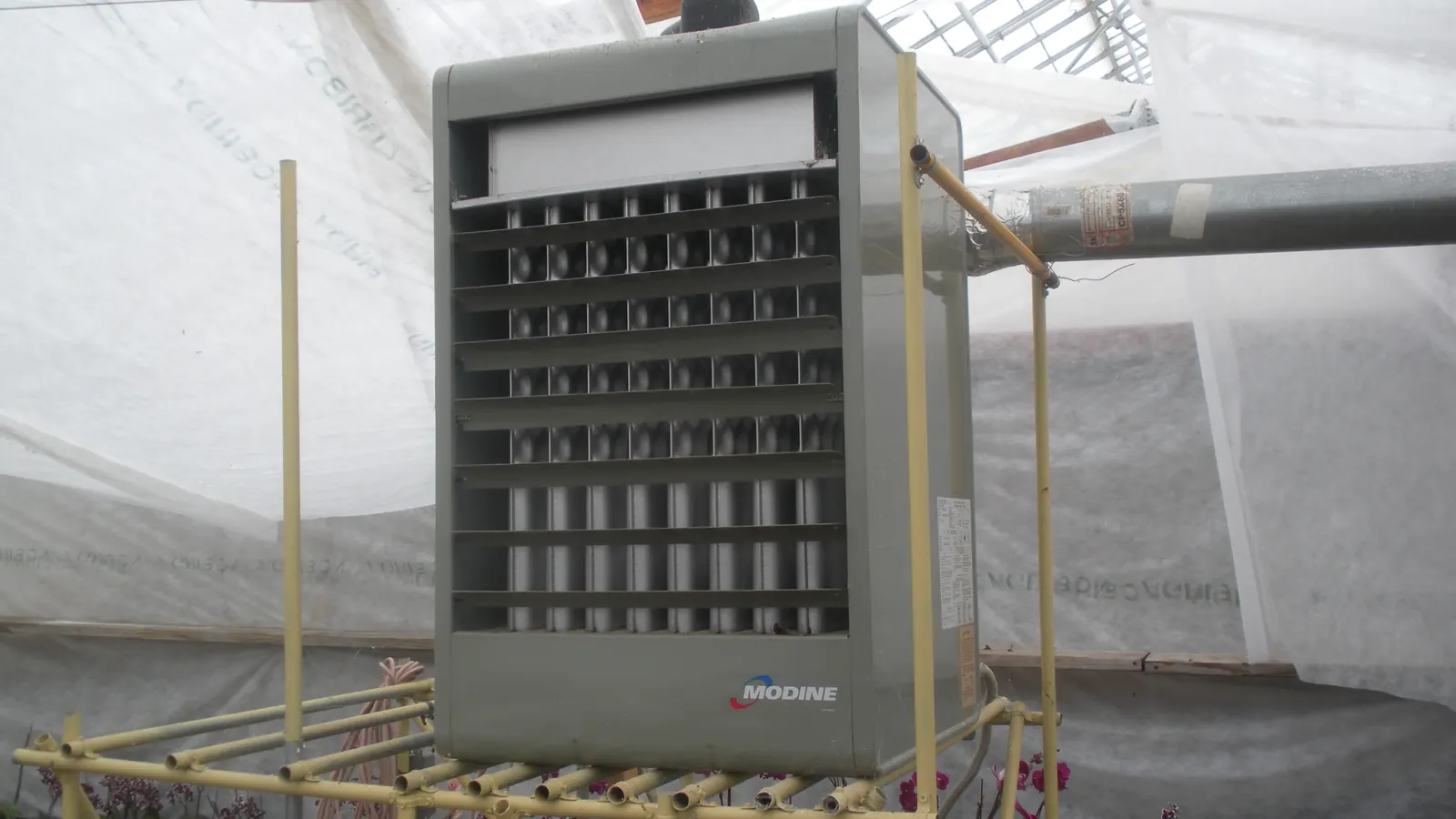
- Fuel-fired: a gas or oil unit heater suits a bigger load but is an installation, with fuel supply, a vent to the outdoors and a source of combustion air.
- Hot water or root-zone: a designed system that warms the media, so it may leave the air cooler than you want.
Manitoba’s guide adds that localized heaters suit smaller operations that do not run all year, and that they can leave hot air near the unit and cooler air farther away.
Combustion heaters: venting is part of the heater
UF/IFAS is direct about unvented or poorly vented gas and oil units. Combustion produces carbon dioxide, which plants can use, but also carbon monoxide, which harms people, and ethylene, sulfur dioxide and unburned hydrocarbons, which harm many plants. The bulletin says exhaust should go outdoors through a stack that rises at least 48 inches above the highest point of the building, and that tight greenhouses need a fresh-air intake sized for the burner, normally 6 to 8 inches in diameter. It also advises keeping stacks and intakes away from tall buildings or trees that could cause a downdraft. Manitoba’s guide warns the same way: unvented heaters can produce gases poisonous to plants and humans. UF/IFAS also advises against fuel-oil radiant heaters of the Salamander type for routine greenhouse heating, because they are unvented, have no thermostat and need close attention whenever they run.
Do not substitute a barbecue, camping heater or other open flame for a unit designed and installed for the job. Have it fitted to the maker’s instructions and local code, and serviced as the manual says. The Consumer Product Safety Commission recommends carbon monoxide alarms and annual inspection of fuel-burning heating equipment, and says never to run unvented fuel-burning appliances in a room where people sleep. If your greenhouse door opens onto a house or garage, an alarm on that side is cheap insurance. CPSC carbon monoxide questions and answers
Electric heaters in a damp room
Water and electricity share this building. Use a heater its maker says is intended for greenhouse or damp conditions, and read what its protection rating covers. Keep the plug, controller and connections out of the irrigation spray whatever the splash rating. Fire-safety guidance for portable heaters generally advises plugging straight into a wall outlet and keeping the heater clear of anything combustible, and electrical codes generally call for GFCI protection on outlets in damp or outdoor locations like this one. Have an electrician add a proper circuit and weatherproof outlet where the existing supply is not up to it, and stop using any heater that keeps tripping a GFCI.
Two examples show the range, without ranking. Bio Green’s Palma digital-thermostat model is listed as PAL 2.0/USDT with 1,500 watts and IPX4 splash protection. We have not tested it, and its stated coverage is no substitute for your own calculation. At a very different scale, Modine describes its PTX/BTX separated-combustion unit heaters as suitable for commercial and agricultural spaces including greenhouses, drawing combustion air from outdoors and venting exhaust outside. Treat that as vocabulary for talking to an installer, not a suggestion to put a commercial unit in a backyard house.
Placement, controls and running cost
Put the thermostat sensor at plant height, out of the heater’s discharge and any sunny corner, and compare it with a separate thermometer on a cold night. If one corner stays cold, look at air movement and sensor placement before turning up the setpoint, and keep trays and foliage clear of the intake and discharge.
Electric running cost is kilowatts times hours times your price per kilowatt-hour. A 1.5-kilowatt heater running flat out for 10 hours uses 15 kilowatt-hours; multiply by your own rate. A thermostat means it runs less on mild nights and more on cold ones. For fuel, ask for an estimate based on the calculated load, fuel units, efficiency and local price, and include installation, vent work and servicing in the comparison. The UMass greenhouse energy checklist lists repairs, insulation and control maintenance. Its savings figures are commercial and historical.
If the power or fuel fails
Settle the plan before winter, because a failed night is not the time to design one.
- Set a trigger: the indoor temperature at which you start moving plants, and a thermometer with an alarm you can hear from the house. A remote alert helps only if the alert itself keeps power.
- Have a frost-free room ready for the vulnerable plants. For a small collection, moving them is usually simpler than backing up with a second heater; for a large or valuable one, talk to an installer about backup capacity.
- Water containers and other thermal mass moderate swings but cannot promise frost protection through a long cold spell, and a seedling heat mat warms only its root zone, not the air.
- After a fuel-fired heater has shut off for lack of power, do not relight it until the vent and intake are clear and the maker’s procedure has been followed.
To choose the structure itself, see the guide to choosing a greenhouse and the greenhouses hub.
Written from manufacturer and retailer information and general garden practice. GardenHelm has not physically tested the products discussed here. How we choose products