Greenhouse Frames: Materials, Cover Compatibility and Structural Questions
Aluminum or steel is only the start: the frame decides where doors, vents and braces go and how much headroom you get. Ask for structural details tied to the exact model.
By GardenHelmPublished 8-minute readMore in Greenhouses
What this guide compares
- Complete frame and covering compatibility
- Site-specific structural documentation
- Connection and bracing details
- Foundation and anchoring requirements
- Replacement parts and accessory support
In this guide
We may earn a commission from links on this page, at no extra cost to you. How this works
Three inches of wet snow, or a foot of dry powder, adds about 5 pounds to every square foot of roof, according to UConn’s high-tunnel engineering notes. On a modest 8 by 10 foot greenhouse that is roughly 400 pounds sitting on the rafters after one storm, and more if it keeps falling. Wind works the other way: it tries to lift a light structure off its base. A greenhouse frame earns its money by handling both loads at your site, so judge it on material, shape, bracing and anchoring together, not on the metal alone.
The parts that carry the load
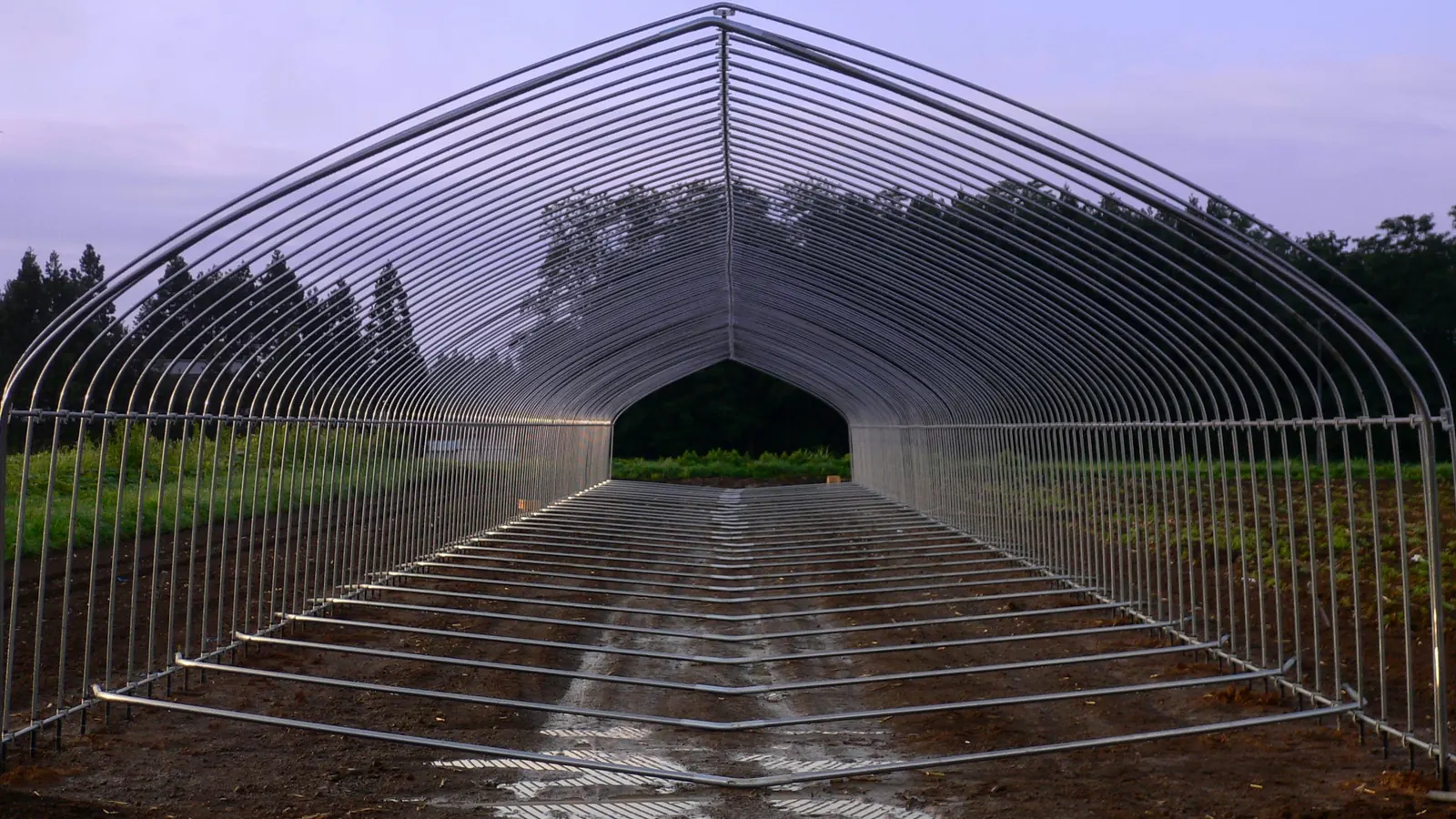
Rafters (or bows, on curved designs) form the roof profile and carry snow down to the side posts. Purlins run lengthwise and tie one rafter to the next, so the frames act together instead of folding like dominoes. Diagonal braces keep the whole assembly square, and the base rail and anchors stop it moving at ground level.
Texas A&M’s greenhouse-structure guide puts typical rafter spacing at 2, 3 or 4 feet depending on the strength required, with purlins every 4 to 8 feet and cross ties added where high winds are frequent. Those figures describe greenhouse construction in general. Your kit’s own drawing is what counts, so ask for an assembled drawing and parts list and make sure every brace in it is in the box. A product photo taken before the bracing went in shows an unfinished structure, not a cleaner design.
Aluminum, steel or wood
Texas A&M calls aluminum the most economical and longest-lasting of the common frame materials, partly because it can be extruded into whatever profile the glazing needs. It does not rust, it is light enough for two people to assemble, and most hobby kits use it. The trade-off is stiffness: a slim aluminum section flexes more than steel of the same size, so in snow country look for heavier profiles, a roof that is braced from the inside, or an optional reinforcement kit.
Galvanized steel is the standard for hoop houses and larger tunnels. UConn lists 14-gauge round tubing of 1.66 or 1.90 inches diameter (depending on tunnel width) as minimum sizes for high tunnels, which shows how much the gauge matters on a span. On a steel frame, ask what coating it carries and how cut ends and drilled holes are protected, because rust starts where the zinc is broken.
Wood is the choice when the greenhouse is meant to look like part of the garden. Texas A&M notes that wood breaks down quickly in greenhouse humidity and should be pressure treated if used, and it warns that PENTA-treated wood gives off fumes harmful to plants. That older guidance is a reason to ask exactly what timber and finish a kit uses, not a shopping list for preservatives. UK maker Alton, for example, uses Western Red Cedar with a factory-applied clear preservative and recommends annual cleaning; it also offers aluminum capping on the glazing bars as an option. Those are details of one range, which may not be sold at a US address, but they show the kind of answer you want from any wood supplier: species, finish, care interval and where water drains away from the timber.
Brackets and fasteners are often a different metal from the main frame, so look at what holds the joints together as well as the members themselves.
Roof shape decides how snow behaves
A pointed gothic arch sheds snow better than a rounded Quonset roof, whose flatter crown lets snow sit. UConn recommends a gothic shape for high tunnels in northern states so that they shed snow. University of Vermont Extension’s collapse-prevention fact sheet adds a useful detail: on a gothic or peaked frame the weak point under snow is mid-rafter, while on a Quonset it is the ridge. If you live where snow lingers, that tells you where extra support belongs.
Bloomcabin’s two steel tunnels isolate the variable. Both pages describe the same frame: zinc-coated steel in a 56 mm (about 2.2 in) Omega profile, 1 mm thick, arches 1 m (about 3 ft 3 in) apart, a 3 m width and a 2.1 m height. An Omega strip is a different section from the round tubing in UConn’s minimums, so the two thicknesses do not compare directly; the maker’s load rating is the figure to check. What differs is the roof. The High Tunnel Greenhouse curves over a rounded crown, the Quonset case, so its crown is the part to watch after a storm. The Sharp Angled version rises to a ridge, as its name and photos show, which is the profile UConn recommends for snow, and moves Vermont’s weak point to the middle of the sloping roof members. Where snow rarely settles, roof shape carries less weight in the choice and the anchoring questions below carry more.
A peaked frame with vertical sidewalls also gives more working room at bench edges than an arch of the same footprint. Sketch your benches and paths on a cross-section, then check the height at the outer edge of each bench, not only at the ridge, and leave room for opening vents and the door swing.
Anchoring against wind
A lightweight greenhouse is more likely to lift than to tip. UConn estimates that an 80 mph wind can put an uplift force of about 220 pounds per linear foot on a high-tunnel roof, and that each ground post must resist roughly 300 pounds of pullout. A hobby greenhouse is smaller, but the principle is the same: the frame is only as secure as its connection to the ground.
That is why the base matters as much as the rafters. A base rail supplied with a kit is usually something that bolts down to a foundation you provide, such as a concrete slab, a footing or anchors set into the ground. Read what the kit expects before choosing a site, and prepare the base level and square to those instructions before assembly. If frame or glazing parts will not line up, stop and contact the supplier instead of forcing them together. Vermont Extension also advises diagonal braces from near the end-wall peak down to the baseboard at all four corners, which keeps the frames vertical and preserves their strength.
For an attached greenhouse, the wall connection and flashing are a separate structural question. Find out which parts the kit supplier covers and which need a local installer.
Wind and snow ratings belong to one exact configuration
Ask for the manufacturer’s wind and snow ratings for the precise size, glazing and base you are buying, and note what anchoring those numbers assume. A brand-wide claim does not cover every model. Your local building department can tell you the design snow and wind loads for your address and whether the structure needs a permit or engineering; talk to them before ordering, especially for anything large or attached to the house.
The rounded High Tunnel’s page shows what a usable rating looks like, and where to push back. It gives a 67 mph wind rating and spells out the conditions behind it: the frame assembled as instructed, every arch at the specified depth (about 13.8 inches into the ground) and the panel, door and window fittings secure. Its snow figure is less tidy. The specification table says 160 kg/m², about 33 pounds per square foot, while the US section of the same page says 43 lb/ft². Ask which applies before you set it against your local design load. The Classic design of Bloomcabin’s Aluminum Greenhouse takes the other route: it says the model has been tested under heavy load, but its specification lists no snow or wind figure, so request the rating for your size and glazing in writing.
Never copy tube sizes, rafter spacing or anchor details from a neighbor’s greenhouse. Strength comes from the whole design and its connections.
The covering has to match the frame
Glass, rigid polycarbonate and film each need their own glazing channels, clips or wire locks, sized for a particular thickness. A rigid panel cut to the right width can still be wrong for the frame’s supports, and heavier glazing adds dead load the frame may not be rated to carry. Get the permitted coverings and replacement specifications in writing.
A configurable kit makes that list longer. On Bloomcabin’s Aluminum Greenhouse, the roof and walls can be ordered in different glazings, from polycarbonate to 0.16-inch tempered glass and several specialty glass types, so two greenhouses on the same frame can carry different panel weights and need different replacement panels. Keep the order confirmation that names the glazing for each face, and ask whether any load rating you are given assumes glass or polycarbonate.
If you are pricing a bare frame, list what is missing: covering, glazing hardware, end walls, doors, vents and foundation materials. The Bloomcabin aluminum-greenhouse page shows complete greenhouse ranges in several design families, not bare replacement frames, so read any quote line by line for its exact contents.
Load you add from inside
Hanging baskets, irrigation lines and grow lights all put weight on the frame, and wet containers are heavier than they look. Hang them only from attachment points the maker approves, and ask which vent openers, shelving and accessories are made for the model. Keep the vents and glazing fasteners reachable after benches go in.
An old frame can be reused when you can identify the model, find its instructions and get compatible glazing and parts. If members are bent, pieces are missing or nobody knows what it is, treat it as scrap rather than a foundation for a new build.
The University of Kentucky’s greenhouse overview frames the whole decision around growing goals and location, and that is the right final test: a frame that suits spring seedlings in a mild, sheltered yard may be the wrong one for winter growing on an exposed hill. For siting and sizing, see how to choose a greenhouse.
Written from manufacturer and retailer information and general garden practice. GardenHelm has not physically tested the products discussed here. How we choose products