Straw Bale Gardening: Site, Conditioning and Planting Decisions
Straw bale gardening grows plants in a conditioned bale, which helps where digging is hard. It still needs a good site, clean straw, steady watering and a readiness check, not just a date.
By GardenHelmPublished 7-minute readMore in Growing & Soil
In this guide
Ask three Extension services how to condition a straw bale and you get three schedules. Arkansas uses urea alone and finishes in ten days. Clemson adds dolomitic lime on day 4 and a balanced fertilizer on day 10. Alabama stretches the job to about 15 days with lime on day 10. What they agree on is the part that matters: you soak the bale, feed it nitrogen so the straw starts to compost inside, and you plant only after that internal heat has died down. Clemson puts the threshold at an internal bale temperature of 99°F or below.
That is the whole method in one paragraph. The rest of this guide covers the decisions around it: which bales to buy, how to set them, how to read readiness, what to plant and how to keep a bale garden watered through summer.
When bales make sense
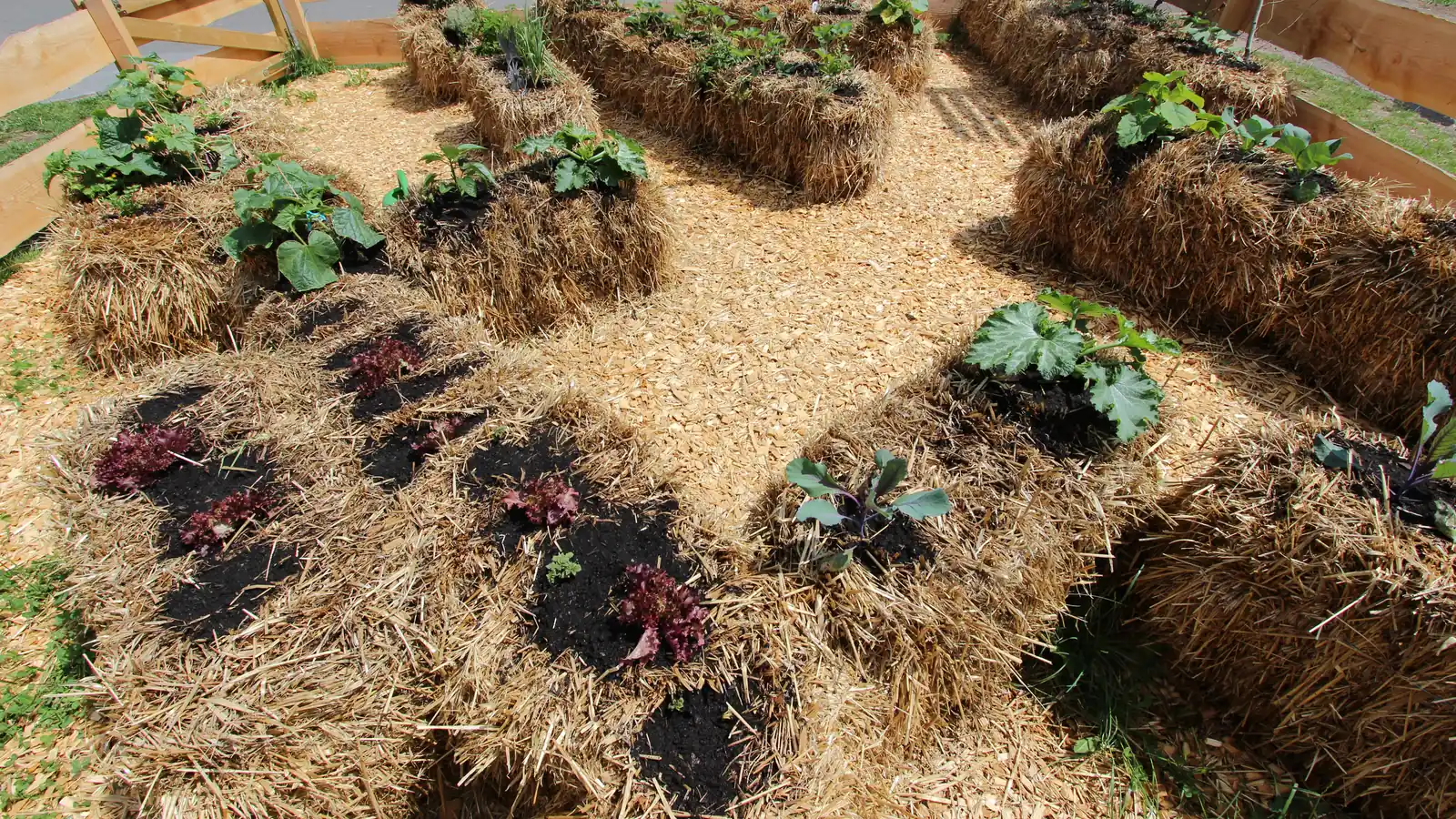
A conditioned bale is a raised bed that composts itself. It suits a spot where digging is hard: compacted or rocky ground, poor soil you have not yet improved, or a gardener who would rather not kneel. It lasts one growing season. Arkansas Extension describes the bales as good for that season and then useful as garden mulch through fall and winter, so you repeat the process each year.
It differs from straw mulch. Mulch sits on top of soil that does the growing. In a bale garden, the decomposing straw and a pocket of potting soil are the root zone.
Pick a sunny site within hose reach. Alabama Extension stresses a well-drained spot near water because a saturated bale becomes too heavy to move, and the University of Maryland’s preparation guide makes the same point. Set bales where they will stay before the first soaking. On a patio or deck, remember that a wet, slowly composting bale will hold moisture against the surface, and that its weight matters on any raised structure.
Buying bales: straw, not hay, and ask about herbicides
Alabama calls wheat straw the best choice. Pine straw breaks down too slowly, and hay brings weed seed because it is cut as forage with leaves and seed heads. Oklahoma State Extension also prefers straw for its lower seed content. An older bale is fine, Alabama says, as long as the twine is still tight.
The question worth asking the seller is what was sprayed on the field. University of Missouri IPM reports that residues of persistent broadleaf herbicides such as picloram, aminopyralid and clopyralid can stay in harvested hay and straw for several years, and that any broadleaf plant, which includes most vegetables and all fruits, can be damaged. In one experiment, contaminated straw cut strawberry yields dramatically. Typical symptoms are leaf cupping, stem curling and distorted leaves. Missouri notes there is no standard bioassay for straw yet, but beans and peas are especially sensitive, so sowing a few in a pot of the straw before you commit is a reasonable early check, with damage typically showing within 2 to 3 weeks. If the seller cannot tell you the field history, buy elsewhere.
Set the bales the right way up
Leave the twine on. It holds the bale together all season.
Clemson’s Home & Garden Information Center recommends placing the bale with the cut ends of the straw facing up and the twine running parallel to the ground, around the sides. Arkansas notes the trade-off: strings on top give a slightly wider planting surface, strings on the sides give a sturdier bale. Clemson and Alabama both put the twine on the sides.
If you plan a soaker hose or drip line, or a trellis for tomatoes or cucumbers, place it now while the bales are light and easy to get around.
Conditioning, day by day
Here is Arkansas’s schedule for its roughly 2-by-3-foot bales, which is the simplest of the published versions:
- Days 1 to 3: soak each bale thoroughly and keep it damp.
- Days 4 to 6: sprinkle ½ cup of urea (46-0-0) on each bale every day and water it in well.
- Days 7 to 9: drop to ¼ cup per bale per day, still watered in.
- Day 10: stop fertilizing, but keep the bale damp.
Arkansas lists bone meal, fish meal or compost as substitutes for a more organic approach, without giving amounts. Clemson offers ammonium sulfate at twice the urea volume (1 cup in place of ½ cup), because it carries less nitrogen. Fertilizers with different analyses are not interchangeable scoop for scoop, so use the amounts given for the product you actually bought.
Clemson’s version adds 2 cups of dolomitic lime per bale on day 4 and finishes with 1½ cups of 8-8-8 or 1 cup of 10-10-10 on day 10. Alabama uses 1 cup of lime on day 10 and then ¼ cup of balanced fertilizer daily through day 15. The University of Maine answered a reader whose bales were slow to heat by noting that Alabama and Clemson differ on lime (1 cup against 2) and advising against adding anything else to buffer the bales. Pick one complete schedule and stick with it.
The bale heats up as the straw starts to break down inside. Cool weather slows conditioning, according to Alabama, so a cold spring can stretch the timeline. Clemson describes the full conditioning period as about 2 to 3 weeks.
How to tell the bale is ready
Push a compost thermometer into the bale from the top, or press your hand into it. Clemson’s target is 99°F or below, roughly body temperature. If it is still hotter, keep watering daily and check again. Alabama adds a texture test: the inside should feel warm and crumbly, not like fresh straw.
Clemson warns that excess heat can harm transplants and seeds, so a few extra days are cheap insurance. Note the dates as you go. If a bale is slow to warm, Maine suggests checking airflow through the sides and watching for matted straw, then being patient.
Planting pockets and how many plants per bale
Arkansas cuts holes about 6 by 6 inches in the top of the bale, fills them with potting soil and sets transplants or seed into them.
Plant counts are where bale gardens get overcrowded. Here is what two Extension services suggest per bale:
| Crop | Clemson | Arkansas |
|---|---|---|
| Tomato | 1 to 2 | 2 to 3 |
| Pepper | 2 | 4 |
| Cucumber | 1 to 2 | 4 to 6 |
| Summer squash | 1 | 2 to 4 |
| Eggplant | 2 | not listed |
| Strawberry | 3 to 4 | not listed |
When in doubt, use the lower number. Clemson advises against corn and okra in bales. Lettuce and beans can follow seed-packet spacing.
Vining and tall crops need support that does not rely on the bale. The straw softens and slumps as the season goes on, so a stake pushed only into the bale will lean. Anchor trellises and tomato stakes in the ground beside the bale (Clemson prefers stakes to cages), or run a cattle panel along a row of bales on posts.
Watering and feeding through summer
Bales dry fast. Clemson says the zone around the roots should never dry out and that daily watering may be needed in hot weather; the outer straw can dry a little, but the interior has to stay moist. A soaker hose laid across the tops on a timer takes most of the work out of it.
Arkansas recommends fertilizing every 2 to 3 weeks during the season, because the decomposing straw does not supply enough on its own. If plants stall or yellow, check watering first, then feeding. Cupped, twisted leaves on tomatoes, peppers or beans point back to the herbicide question above, not to a nutrient shortage.
After the harvest
By fall, a bale is a sagging mound of partly composted straw. Pull the twine and any drip line, then spread the remains as mulch or add them to the compost pile, as Arkansas suggests, provided the season gave you no sign of herbicide damage. If it did, keep that material away from vegetable beds.
Next spring, start with fresh bales. Before you buy more, think about which crops were easy to reach and water. Tomatoes and peppers at the lower per-bale counts are the most forgiving start; sprawling squash makes a bale row hard to walk around.
Written from manufacturer and retailer information and general garden practice. GardenHelm has not physically tested the products discussed here. How we choose products