Expandable Garden Hose: Pressure, Reach and Storage Tradeoffs
An expandable hose stores small and stretches under pressure, which suits a patio. Know the gap between working and burst pressure, and how much reach you really get.
By GardenHelmPublished 4-minute readMore in Irrigation
In this guide
Consumer Reports once tested three 50-foot expandable hoses (the DAP XHose, FlexAbleHose and Pocket Hose) and found each weighed about a pound, stretched to roughly three times its resting length and delivered flow comparable to a regular hose. News report on the Consumer Reports test That is the appeal in one line: a hose that hangs on a hook and handles like a bundle of string. The same report also holds the catch. The hoses shrank when pressure dropped, and a hole could not be patched.
Those two facts frame the rest of this guide. An expandable hose is a good fit for a particular routine, and it comes with failure points a rubber or polyurethane hose does not have.
How it works
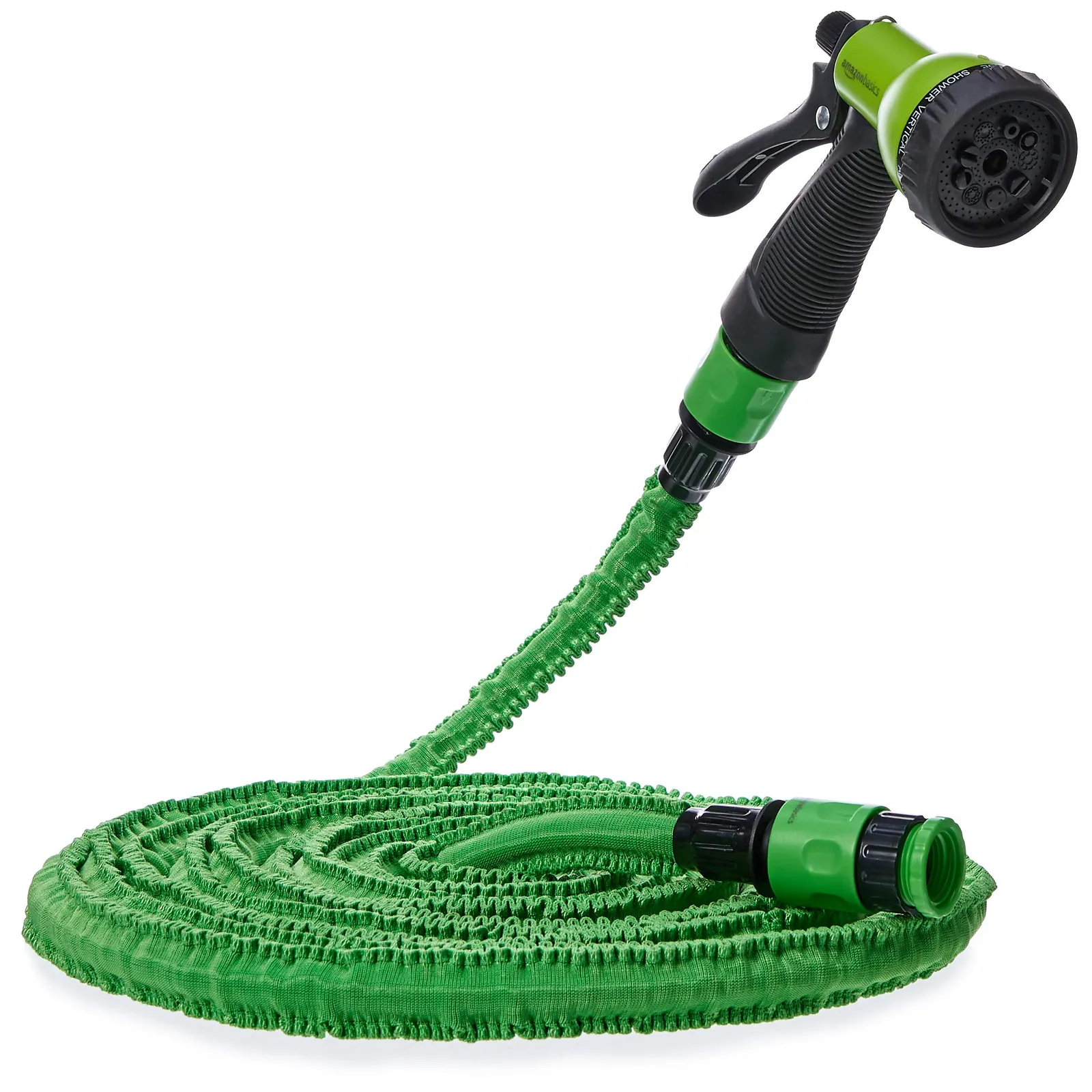
The usual construction is an elastic inner tube inside a woven fabric outer sleeve. With the nozzle closed and the tap on, water pressure inflates the tube, and the sleeve limits how far it stretches. Turn the water off and open the nozzle, and the elastic pulls the whole thing back to its short length. The sleeve is what you see and handle; the thin inner tube is what holds the water.
Two numbers define what you get, and they are not the same. The first is the length when contracted, the second the length when expanded. The Pocket Hose Copper Bullet specification panel lists the 50-foot version at about 16.7 feet contracted, says 40 PSI produces less than threefold expansion and says 58 PSI is needed for full expansion. Those are that maker’s figures for that hose. If your faucet runs below the stated pressure, you get a shorter hose than the box suggests, and it is not defective for doing so.
Measure your route around the real corners rather than the straight line, and leave slack. Do not plan on a hose stretched to its last inch.
Where they fail
Most of the weak points follow from the construction.
The inner tube cannot be repaired. Consumer Reports noted that holes cannot be patched and that the outer covering needs careful handling. A conventional hose can take a mender; an expandable one generally means replacement, and a generic repair fitting made for ordinary hose may not suit it. Before cutting anything, ask the maker whether it supplies a repair procedure and parts for that exact version.
Dragging and snagging. The fabric is the only thing between the thin tube and the ground. Pulling it over gravel, bed edges and concrete corners is the thing to avoid, and a hose that must be dragged a long way suits poorly.
It contracts when pressure falls. Consumer Reports saw the hoses shrink when the valve was opened wide to fill a kiddie pool, and noted that a hose feeding a sprinkler can pull the sprinkler through the garden when the water is shut off. That points to hand watering as the natural use.
Fittings and the stretch. The ends take the strain of every expansion. If a joint weeps, find out whether it is at the faucet, the hose end or the body before you contact the supplier, and photograph it with the model number.
Pressure ratings: working versus burst
The Copper Bullet page lists 80 PSI maximum working pressure and a 650 PSI burst claim separately. Only the first is an operating limit. If a listing quotes a dramatic burst figure and no working pressure, ask for the working limit before buying.
Follow the shutdown routine
The Telebrands Silver Bullet instructions, dated 2018, show the sequence for that model: attach the nozzle closed, attach the inlet, turn the supply on and let the hose fill, then open the nozzle. At the end, turn the supply off, open the nozzle to drain the hose and store it indoors once it is fully drained. The sheet warns against pulling an empty hose to stretch it, leaving it unattended under pressure and using it with hot water, commercial service or pressure washers. Those are the rules for that documented version, so read the leaflet that came with yours.
Be honest about whether you will actually follow that routine. If the hose will sit connected in a distant corner of the yard all summer, choose equipment designed for that kind of service.
Matching the job
- Hand watering is the sweet spot: you control the nozzle, move around, and put the hose away.
- Sprinklers need confirmation from the hose maker, given the contraction behavior above.
- Timers or fixed systems leave pressure on the hose for long periods, so the whole arrangement must be permitted.
- Pressure washers need an explicit statement of compatibility; a garden-hose thread does not make an expandable hose an approved supply line.
Check the package contents too. A product image may show a hanger, a bag or a nozzle that belongs to a different option. Keep the instructions and warranty somewhere you can find them.
Drinking water and durability
Fabric color and metal fittings do not establish drinking-water suitability, so use the exact product’s written intended use, and make no assumption otherwise. We have not run a durability comparison, and none of the sources above ranks these hoses for lifespan. Compare written warranties and whether replacement parts exist for the model instead of trusting a star average. Our irrigation guides cover conventional alternatives if a reel and a standard hose suit you better.
Written from manufacturer and retailer information and general garden practice. GardenHelm has not physically tested the products discussed here. How we choose products